
276 tonnes of medical cannabis flower. C$643 million in export value. Roughly three-quarters of the world’s legal medical supply. Canada’s 2025 export data does not merely extend a growth trend — it redefines the country’s position in the global cannabis trade. In a single year, volumes more than doubled, a single regulatory event in Europe rewrote the destination map, and pricing dynamics diverged sharply enough to separate the operators building durable margin from those exposed to commodity compression. The data, compiled from Statistics Canada customs records (HS 1211.90.10) and Health Canada export permits, tells a story of structural acceleration — and of the concentrated risks embedded within it.
Table of Contents
Three things to know before reading further. First, Canada exported 276 tonnes of medical cannabis flower in 2025 — a sixth consecutive annual record, compounding at roughly 55% per year since 2021. Second, Germany absorbed 32% of the volume and 46% of the value, driven almost entirely by one regulatory shift: the April 2024 reclassification under the Cannabisgesetz. Third, growth is softening — Q4 2025 and January 2026 show faltering volumes and prices, the first deceleration signal in six years.
The volume story: near-exponential growth, one market deep
The trajectory from 2021 to 2025 follows a near-exponential curve: 41 tonnes, 59, 78, 116, then 276. That final leap — a +138% year-on-year increase — is historically unprecedented in legal cannabis trade, compounding at roughly 55% annually over the five-year period. To find a comparable acceleration in agricultural commodity exports, one would need to look at post-war reconstruction cycles or the early years of Chilean salmon farming. The difference is that Canada’s surge rests on a narrower foundation than either. The cumulative total since 2018 now stands at approximately 611 tonnes of flower shipped across borders — and nearly half of that lifetime total was exported in 2025 alone. Germany is that foundation. The country imported 89 tonnes of Canadian flower in 2025, up from 22 tonnes the year before — a fourfold increase driven by the scaling of the medical cannabis patient base following the April 2024 reclassification under the Cannabisgesetz.
For context, Germany’s imports from Canada in 2021 were just 7 tonnes; the market has grown twelvefold in four years. Strip out Germany’s contribution and total 2025 volume falls to approximately 187 tonnes: still a record, but representing +61% growth rather than +138%. The acceleration is, in the strictest sense, a Germany story. Australia, the second-largest market, grew from 44 tonnes (2024) to 65 tonnes (2025) — a solid +50% increase, but modest compared to Germany’s step-change. Israel rebounded to 40 tonnes after a subdued 14 tonnes in 2024, while Portugal surged from 18 tonnes to 46 tonnes, reflecting the scaling of the re-export corridor.
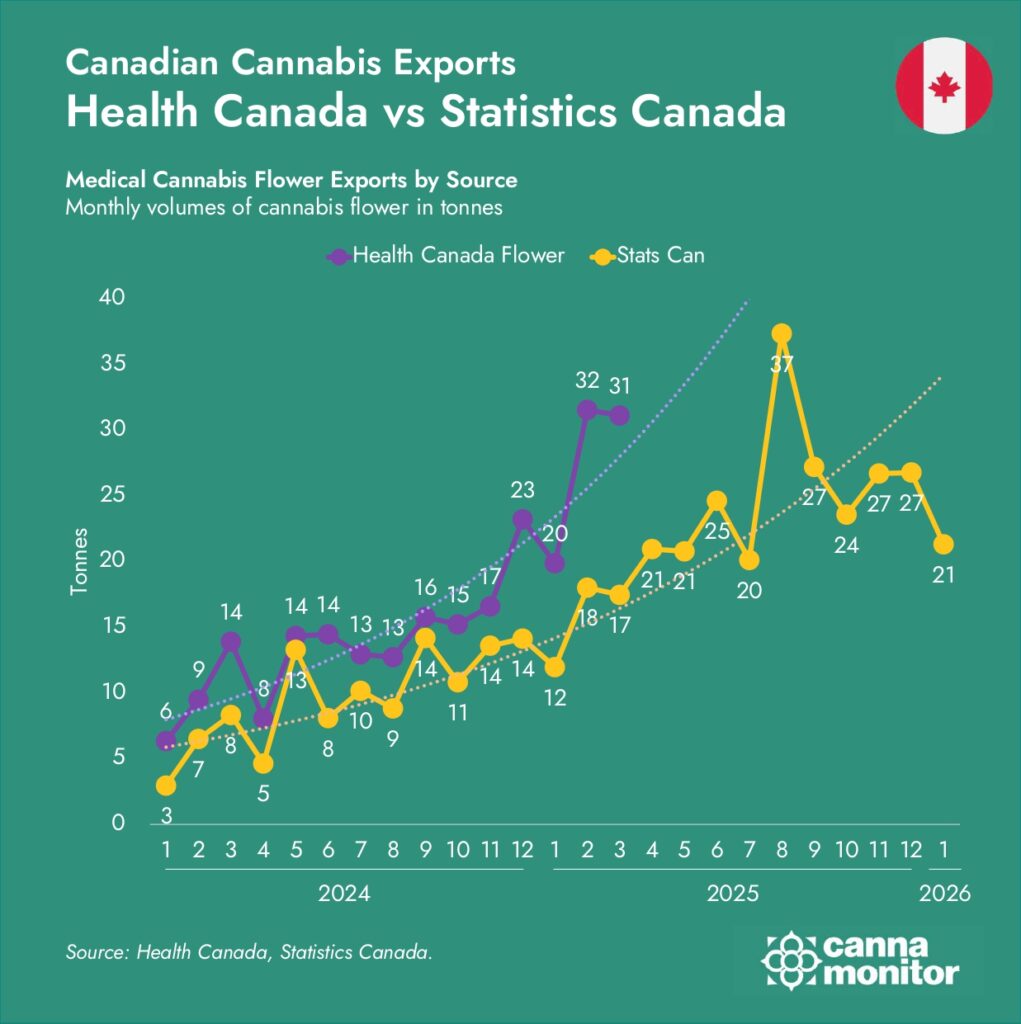
Within 2025, the quarterly cadence tells a story of rapid acceleration followed by an unresolved inflection. Q1 opened at 47 tonnes, already exceeding the 39 tonnes recorded in Q4 2024. Q2 jumped to 66 tonnes as Germany’s summer demand cycle kicked in, with 22.5 tonnes shipped to Germany alone in that quarter. Q3 reached 85 tonnes — the single largest quarter on record — driven by a concentrated 27 tonnes to Germany and a 21-tonne shipment cluster to Australia. Then Q4 pulled back to 77 tonnes, and January 2026 registered just 21 tonnes. Whether the Q4 moderation reflects permit timing, seasonal demand patterns, inventory destocking at the distributor level, or the early signs of structural demand softening remains an open question. The data is too recent to distinguish signal from noise, but the direction warrants close attention — particularly given that January 2026’s annualised run rate (~255 tonnes) would fall short of the 2025 total for the first time in the series.
On the supply side, the provincial concentration is as striking as the destination concentration. Ontario accounted for 181 tonnes — 66% of all flower exports — consolidating its dominance as the home of most EU-GMP and GACP-certified large-scale producers. That is up from 71 tonnes (61%) in 2024 and 52 tonnes in 2023, a trajectory that mirrors the industry’s capacity build-out in the Greater Toronto and southern Ontario corridor. British Columbia contributed 49 tonnes (18%), up from 20 tonnes the prior year — its sharpest share increase in the series, likely driven by one or two operators scaling EU export licences from purpose-built indoor facilities. Quebec added 24 tonnes (9%), up from 17 tonnes in 2024, a steady but unspectacular contributor. Alberta emerged with 8 tonnes, up from 2 tonnes in 2024, suggesting a new certified exporter entering the market. New Brunswick, historically significant in the early export years (peaking at 8 tonnes in 2022), contributed 9 tonnes but has receded as a share of the national total. Saskatchewan (2 tonnes), Nova Scotia (2 tonnes), and Manitoba (<1 tonne) round out the picture. The Ontario–BC duopoly — controlling 84% of national export volume — reflects the geographic concentration of certified production infrastructure. It is simultaneously an execution moat for incumbents and a structural bottleneck: any material increase in national export capacity requires either existing Ontario/BC operators to expand or new entrants in other provinces to secure EU-GMP certification, a process that typically takes 18–24 months from application to first shipment.
Annual Canadian flower exports by destination, 2018–2025 (tonnes)

Quarterly Canadian flower exports by destination, Q1 2024–Q4 2025 (tonnes)

Annual flower exports by province of origin, 2021–2025 (tonnes)

Market structure: concentration, corridors, and the Germany system
Three markets absorbed 70% of Canada’s 2025 flower exports by volume: Germany (89 tonnes, 32%), Australia (65 tonnes, 23%), and Israel (40 tonnes, 15%). Add Portugal (46 tonnes, 17%) and the top four account for 87%. This is not diversification.
Canadian Cannabis Exports — Annual Value by Market (C$M)
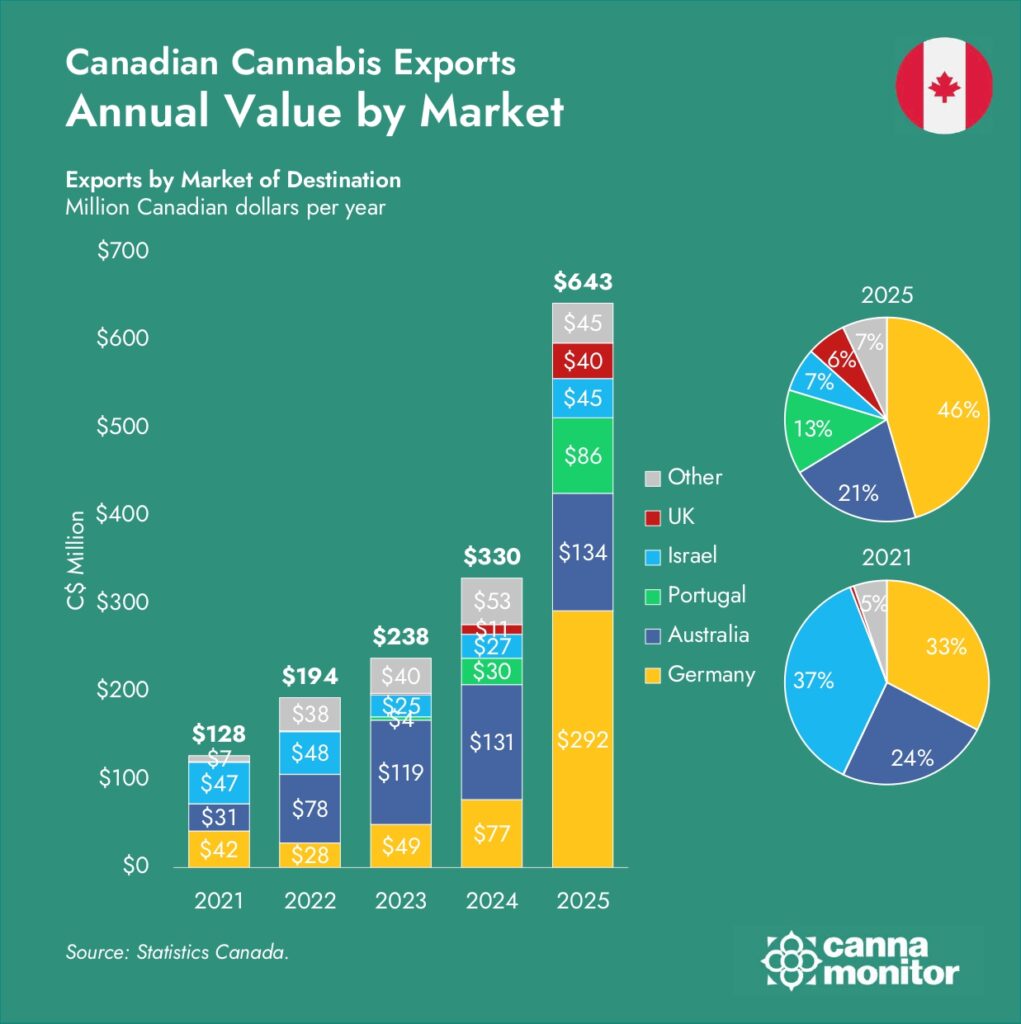
The concentration is, in fact, deeper than the headline numbers suggest. Portugal, Czechia, and Malta do not function primarily as final demand markets. They are processing and re-export hubs — jurisdictions where operators import Canadian flower, repackage or process it under their own EU-GMP licences, and ship predominantly to Germany. The economic motive is a certification arbitrage: some Canadian producers cannot yet sell directly into Germany and route through EU-licensed intermediaries instead.
The implication is significant. Canada’s direct exports to Germany totalled 89 tonnes. Add the estimated re-export volumes from Portugal (46 tonnes), Czechia (10 tonnes), and Malta (1 tonne) — the vast majority of which flow onward to Germany — and Canada’s effective supply into the German market exceeds 130 tonnes. Against an estimated national demand base of approximately 800 tonnes, Canadian-origin flower already supplies upwards of 16% of Germany’s total cannabis consumption, embedded across multiple supply-chain nodes.
This reframes the concentration risk. It is not merely Germany-as-destination, but Germany-as-system. A regulatory shift in Germany — whether in prescribing norms, domestic cultivation policy, or reimbursement caps — would cascade simultaneously across the direct export corridor and all three re-export hubs. The operators most exposed are those reliant on the Portugal and Czechia arbitrage routes rather than direct in-market distribution.
The United Kingdom, meanwhile, is the clearest next unlock. At 15 tonnes and C$40 million in 2025, the UK corridor grew +267% year-on-year in value — the fastest rate among established markets. At C$2,289 per kilogram FOB, it sits above Australia’s C$1,728 and below Germany’s C$3,175, suggesting a maturing but still premium-priced market with room for volume expansion as the private prescribing ecosystem deepens.
Pricing: compression is real, but the premium still has an address
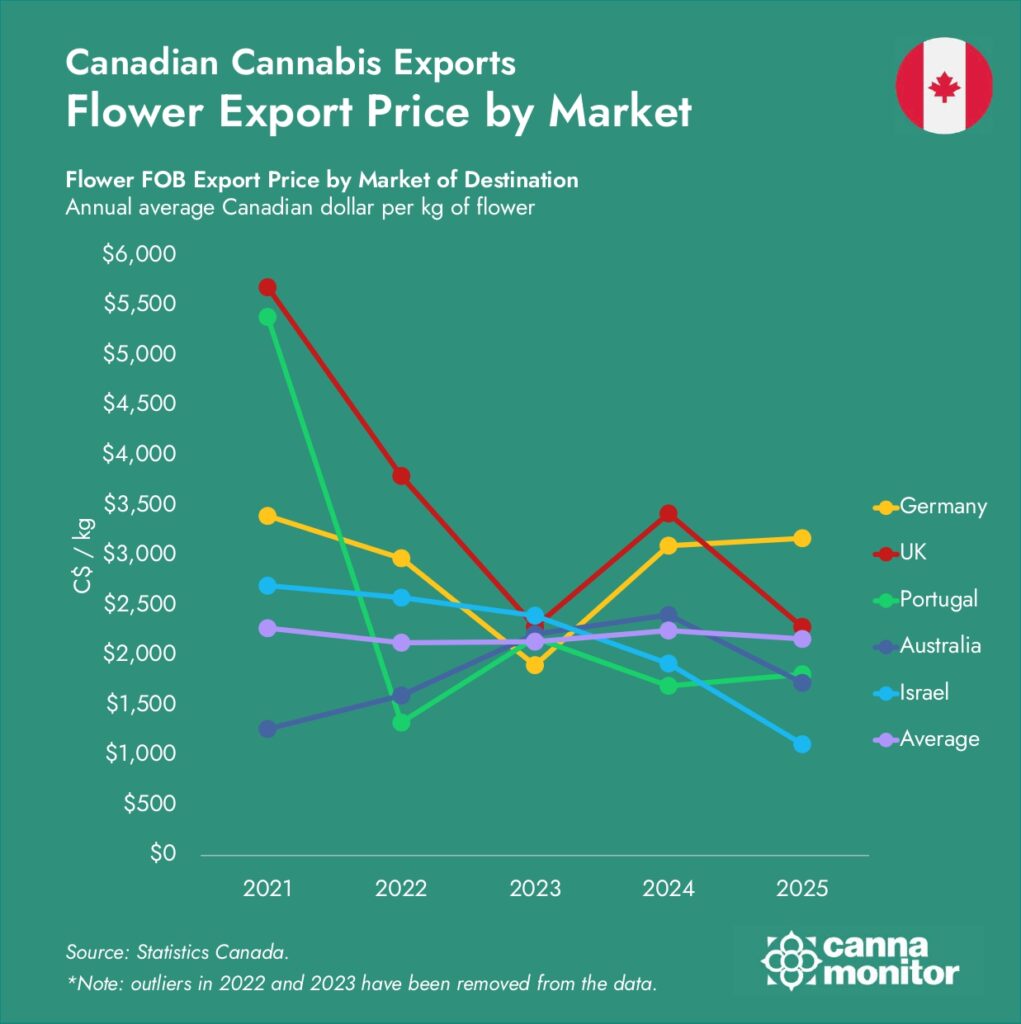
The weighted average FOB price for Canadian flower exports has compressed from C$2,826 per kilogram in 2020 to C$2,168 in 2025 — a decline of approximately 23% over five years. January 2026 data shows further softening to C$1,872 per kilogram. The direction is clear: more flower is leaving Canada at lower unit economics.
But the aggregate masks a story of sharp market-level divergence.
Germany holds the premium. At C$3,175 per kilogram in 2025 — broadly stable since the C$3,398 recorded in 2021 — it remains the highest-priced major destination. The floor is set by EU-GMP pharmaceutical-grade certification requirements, which create a structural quality barrier and limit price erosion to competition among certified suppliers rather than a race to the bottom. For producers with direct German market access, pricing power is intact.
Israel tells the opposite story. From a scarcity-driven peak of C$22,500 per kilogram in 2019 — a first-mover premium when legal medical imports were novel and supply constrained — the price has collapsed to C$1,114 per kilogram in 2025. The cause is straightforward: domestic Israeli production scaled, eliminating the import premium entirely. Israel is now a volume market at commodity economics.
Australia sits in between, on a sustained multi-year compression trajectory: C$3,982 per kilogram in 2018, C$1,728 in 2025. The TGA access scheme has matured, the prescriber base has expanded, and competitive pressure from multiple Canadian and increasingly domestic suppliers has disciplined pricing year after year.
Portugal, functioning as a re-export hub rather than a final market, compressed from C$5,389 per kilogram at market entry in 2021 to C$1,814 in 2025. The hub dynamics themselves suppress price — intermediaries extracting margin between Canadian FOB and German wholesale inevitably compress the upstream price paid to Canadian exporters.
The strategic read is that pricing power now sits with two characteristics: EU-GMP certification and direct in-market distribution. Operators selling certified, differentiated flower directly into Germany and the UK retain margin. Those reliant on bulk arbitrage through processing hubs face structural compression as more certified supply enters the system.
Canadian Cannabis Exports — Flower Export Price by Market (FOB C$/kg)
Flower dominance and the export imperative
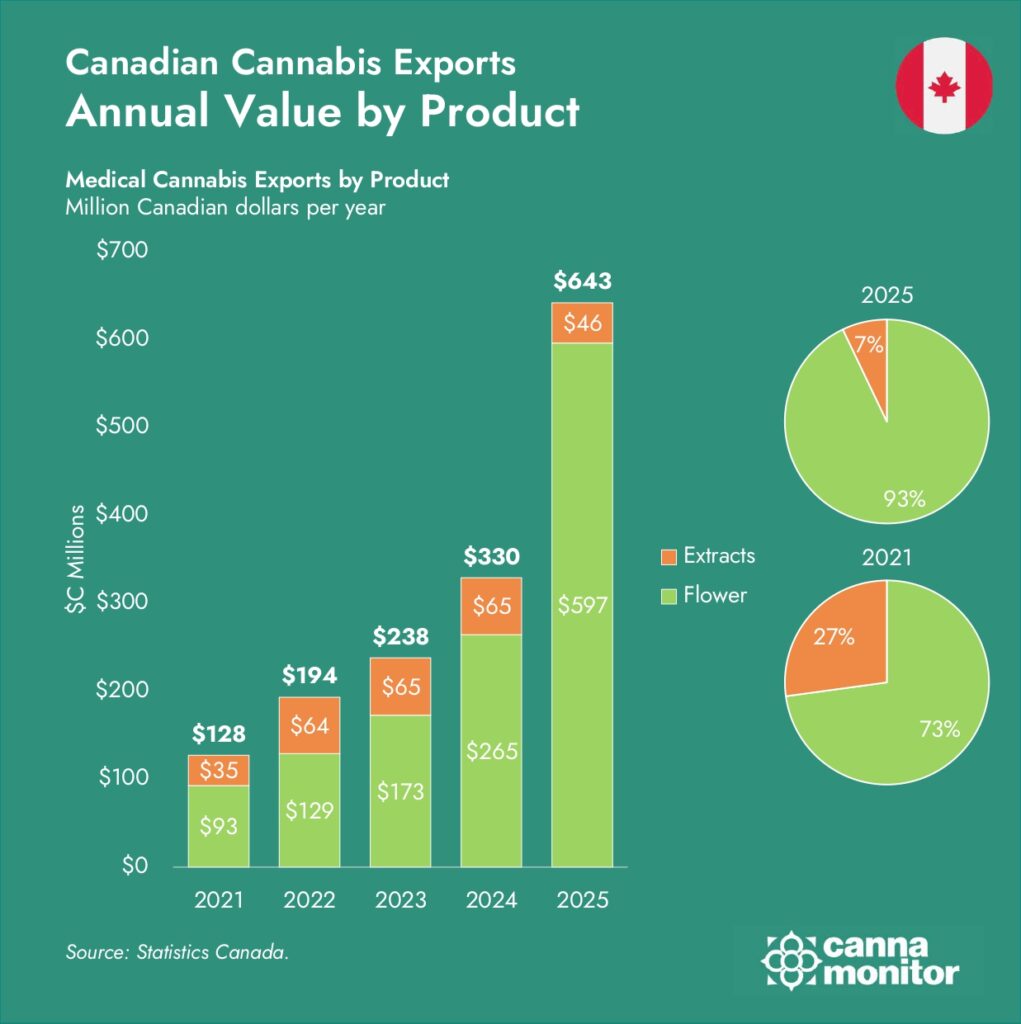
Of the C$643 million in 2025 medical cannabis exports, C$597 million — 93% — was flower. Extracts contributed just C$46 million, down from a 27% share in 2021. This is not a cyclical shift. It is structural, driven by the regulatory preferences of the two largest markets.
Canadian Cannabis Exports — Annual Value by Product (C$M)
Domestic Market Value (C$B)

Germany’s April 2024 legalisation created demand specifically for flower (Blüten), not for extracts, which remain under stricter prescribing norms. Australia’s TGA similarly channels most import volume through flower-dominant products. Extract exports have flatlined at C$46–65 million per year since 2022, and the trajectory suggests continued marginalisation unless European prescribing norms shift toward oral formulations — a change that would require Canadian exporters to retool certified product lines and invest in infrastructure not currently priced into export capacity planning.
The domestic context sharpens the strategic logic. Canada’s total cannabis market reached C$9.4 billion in 2025, but domestic medical demand has been essentially flat at C$0.41–0.47 billion per year since 2021 — a structural ceiling. The adult-use market (C$6.31 billion) absorbs most domestic production at low margins and under excise tax. Export flower, by contrast, commands a C$2,000–3,000+ per kilogram premium over domestic wholesale prices and carries no excise tax. The C$643 million in flower export revenue represents roughly 10% of the domestic legal adult-use market value — but at a disproportionately higher margin.
For the top Canadian licensed producers, international has moved from a growth story to the core business. Aurora Cannabis now earns a majority of revenues internationally, inverting what was, until 2023, a predominantly domestic operation. The operators that built in-market distribution — regulatory affairs teams, pharmacist relationships, branded product portfolios — rather than relying on bulk arbitrage through processing hubs are better positioned for the next cycle. Systemic oversupply in the global market is likely to persist, and the competitive pressure will intensify.
What the data says — and what it does not
A note on the data itself: two official sources cover Canadian medical cannabis exports, and they do not always agree. Statistics Canada records customs-declared trade data at the point of export clearance; Health Canada records export permit data at the point of issuance. For full-year 2025, Statistics Canada reports 276 tonnes; Health Canada implies approximately 248 tonnes — an ~11% gap likely explained by batched customs clearances and re-classified shipments. The August 2025 spike (37 tonnes in Stats Can vs 20 tonnes in Health Canada) is the clearest single-month divergence. This analysis uses Statistics Canada as the primary source for volume and value; Health Canada is used as a cross-reference for permit timing.
The 2025 Canadian export data confirms what many in the industry have quietly known for two years: Canada is the weedbasket of the world. The scale is now undeniable — 276 tonnes, C$643 million, roughly 75% of global legal medical supply.
But the data also exposes the fragility beneath the headline. Growth is Germany-dependent. Pricing is compressing in every market except Germany. The product mix is locked into flower by regulatory design, not by strategic choice. And the first deceleration signals — Q4 2025 and January 2026 — are visible in the quarterly series for the first time in six years.
The operators that will thrive in the next phase are those that have built structural advantages: EU-GMP certification, direct market access, diversified destination portfolios, and branded product differentiation. The operators that relied on volume growth and processing-hub arbitrage face a more difficult environment as the global supply base widens and pricing converges downward.
Canada built the weedbasket. The question now is whether its contents hold their value.
Canadian Cannabis Exports — Health Canada vs Statistics Canada