


Licensing is emerging as the industry’s most decisive category, squeezed between renewal backlogs, new registration regimes and overnight reclassifications — even as medical cannabis frameworks mature into a different fight: not whether patients can access product, but which suppliers clear the paperwork to reach them. Export-led supply chains are colliding with reimbursement rollbacks and record enforcement seizures.
Key figures from July 2026 include:
- Germany ends flower reimbursement for ~65,000 patients under the BStabG
- Canada‘s recreational market grows just 0.6% YoY as pre-rolls overtake flower at 36%
- Portugal‘s Infarmed delists over 30% of operators, cutting export licences 48 → 34
- Jersey approves 167 UK export licences in 2025, up from 87, in ~48 hours each
- UK Border Force seizes a record 167,000kg; four in five airport seizures are Thai-origin
- UK pharmacists dispense 441,409 private items to doctors’ 209,644
- Israel hits a record 143,900 patients, up 8,700 since December
- Peru registers 55,000+ patients; only 34% access legally
Feel free to contact us at info@cannamonitor.com with any suggestions.
New Article:
Supply Chain Risk in Europe 
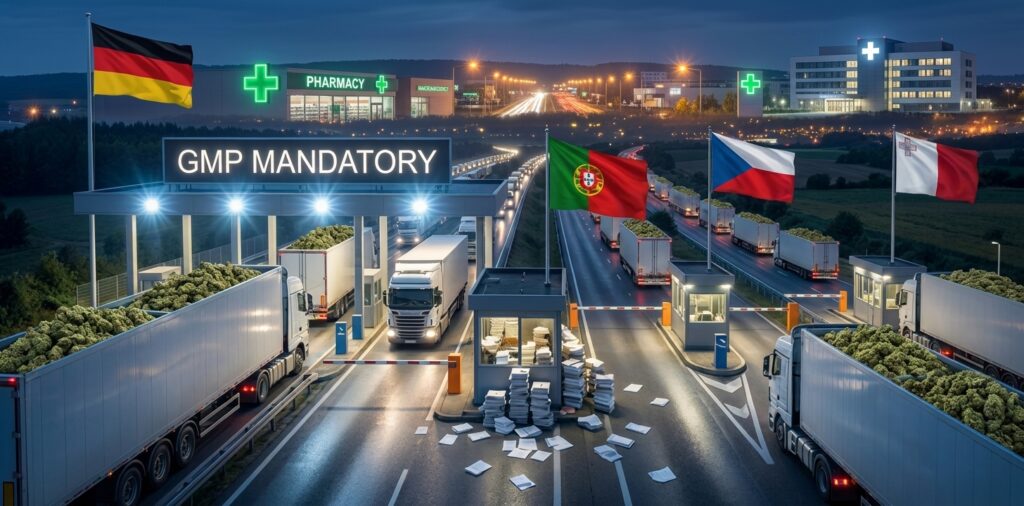
Behind Europe’s supply chain: a consolidation that never came 
Cannamonitor’s latest free datapack maps how Europe’s cannabis supply chain actually settled — who holds the EU-GMP certificates, which routes carry the volume, and why the consolidation everyone forecast never arrived. Access it now.
 Regulation
Germany ended statutory reimbursement of cannabis flower, with magistral extracts covered only after a six-month course of an approved medicine. The DEA closed its rescheduling hearing, with Schedule III briefs due 17 August, as the 12 November hemp-THC ban split the states. Portugal‘s Infarmed blackout delisted over 30% of licensed operators, cutting export licences from 48 to 34, while Dutch MPs were warned of a 2–3 year patient supply gap. Brazil‘s Supreme Court will set binding criteria for court-ordered supply. Sweden classified THCA and 17 other substances as narcotics. Japan issued its first private-sector research cultivation licence.
 Market
Vireo extended its buying spree with Cannabist and Planet 13, building the largest US retail network at ~265 dispensaries. German pharmacy prices kept sliding, to ~€4/g on record dispensed volumes. Australia‘s ASX reporting season delivered record revenues built on export deals. Canadian recreational sales grew just 0.6% YoY as pre-rolls overtook flower at 36%. Israel‘s patient base hit a record 143,900. Curaleaf registered Spain’s first standardised preparations. Poland‘s clinics settled around a PLN 199 median first consultation, commoditising the price of access. Jersey‘s export licences reached 167, with Northern Leaf shipping 3,590kg of flower to Germany.
 Science
German data found no youth-use surge after legalisation, but a third more cannabis hospital admissions. A Lancet Psychiatry review linked commercialised legalisation, rather than legal status alone, to higher use and cannabis-use disorder, and MediPharm‘s Phase II LiBBY trial cut agitation in advanced Alzheimer’s disease.
Infographic of the Month:
Price reset in Germany

 United States — DEA rescheduling hearing concludes, with a Schedule III ruling pending after 17 August briefs
 On the radar: Parties file DEA post-hearing briefs on 17 August; the administrative judge then issues a Schedule III recommendation. The 0.4 mg/container federal intoxicating-hemp ban takes effect on 12 November unless Congress changes course. North Carolina’s HB 328 awaits a House vote.
Regulation — 17 August briefs and 12 November hemp ban set federal tests
The DEA’s rescheduling hearing closed on 15 July; parties now file post-hearing briefs by 17 August before an administrative judge recommends whether cannabis moves to Schedule III. The recommendation is not the final scheduling decision, but it sets the next federal step.
- The DEA‘s own pharmacologist testified that marijuana fails the agency’s accepted-medical-use standard.
- The DOJ opposed the intervenors’ stay motion, arguing that anti-rescheduling parties’ commercial interests do not align with the public interest.
- The pending change is already driving tax and state conflicts: the IRS sued TerrAscend over 280E refunds.
- Wyoming opted out of federal rescheduling, keeping marijuana Schedule I under state law.
The federal intoxicating-hemp ban takes effect on 12 November, setting a 0.4 mg THC-per-container limit that would remove nearly all intoxicating-hemp products from legal sale. The House’s Lawful Hemp Protection Act would prevent that outcome.
- Florida hemp businesses say ~95% of products are at risk before the deadline.
- North Carolina‘s Senate passed HB 328 to ban most intoxicating-hemp THC and restrict kratom; next step: House vote.
- A federal judge blocked Ohio’s hemp-beverage ban for the plaintiff firms pending the full case.
Nebraska approved permanent medical-cannabis regulations, completing the rulebook for its voter-approved programme.
- Idaho‘s medical-cannabis initiative failed to qualify for the November ballot.
- Oklahoma operators said child-safe-edibles rules remain unclear.
- Adult-use licensing moved in three states.
- New York approved 24 adult-use licences and updated medical-cannabis regulations at its 2 July meeting.
- San Francisco approved cannabis cafés, a Bay Area first.
- Rhode Island reset its retail-licensing round, refunding applicants and reopening the process.
Market — Vireo’s back-to-back deals build the largest US retail network at ~265 dispensaries
Vireo Growth agreed to acquire Cannabist assets and Planet 13 in back-to-back deals, creating a pro-forma network of ~265 dispensaries — the largest cannabis retail footprint in the US.
- Planet 13 joins via an all-stock acquisition announced days later.
- Consolidation ran beyond Vireo: SNDL completed its Parallel acquisition, adding ~US$150m in revenue and positioning for Nasdaq-consolidated US medical operations.
- Standard Wellness acquired a Cleveland licence while divesting two Ohio stores.
Chicago Atlantic provided US$62.5m in second-lien financing secured on 32 retail properties — selective credit is still flowing even as bankruptcy and layoffs spread through the downturn.
- Ascend Wellness sought a reverse stock split to support a planned US uplisting.
- Distress concentrated on the supply side: The Cannabist Company closed its Denver cultivation site in bankruptcy, eliminating 50 jobs.
- CannaCraft and NorCal Cannabis cut 100+ California jobs amid the state’s downturn.
Illinois H1 adult-use sales reached US$684.3m with units up 9.3% as average prices slid — volume growth, not pricing, is now carrying revenue in maturing adult-use markets.
- Oversupply strain ran deeper further west: Washington‘s 2025 sales fell to US$1.14bn amid oversupply and heavy taxes.
- Story Cannabis bet on profitability over footprint across its five states.
- Georgia‘s expanded medical programme pushed active patients past 41,400.
Hemp Beverage Alliance published the category’s first verified wholesale dataset, showing sales up 133% YoY to 1.6m cases — scale arriving three months before the federal hemp-THC ban takes effect.
- Cann launched a THC-free 0MG line ahead of the 12 November ban.
Science — Lancet review ties commercialised legalisation to higher use and cannabis-use disorder
The Lancet Psychiatry review linked commercialised legalisation to higher use and cannabis-use disorder, with mixed evidence on psychosis — placing the commercial model of legalisation, rather than legal status alone, at the centre of the risk debate.
MediPharm Labs reported positive Phase II LiBBY results: a significant reduction in agitation associated with advanced Alzheimer’s disease and dementia.
- Acute high-THC smoking raised inflammatory cytokines but not insulin sensitivity in a controlled human trial.
 Germany — statutory insurers stop reimbursing cannabis flower, hitting ~65,000 patients
On the radar: ACM’s constitutional complaint against the flower-reimbursement cut is being prepared for filing with the Federal Constitutional Court.
Regulation — Constitutional complaint and pharmacy price-fix counteroffers meet the 10 July law
Bundestag and Bundesrat passed the BStabG on 10 July, ending statutory-health-insurance (GKV) reimbursement of medical cannabis flower — a structural break projected to hit ~65,000 patients (≈⅓ of flower users) against €205m of 2025 GKV cannabis spend.
- Extracts stay reimbursable only after a six-month course of an approved cannabis medicine.
- An earlier draft had also curbed extracts and dronabinol reimbursement, alongside nabilone.
- Legal and industry pushback was immediate: ACM announced a constitutional complaint against the law.
- Pharmacists and Bloomwell argued a Hilfstaxe price fix — a change to the pharmacy pricing schedule — would save more, warning of higher downstream costs.
- Swiss patient association MEDCAN warned the rollback reverses access gains won since 2022.
Most Länder medicines authorities backed Hesse’s GMP drying requirement for medical flower, with Saxony-Anhalt the sole partial exception — a de facto national tightening of production standards.
- Northern Leaf‘s CEO urged harmonised GACP-to-GMP rules and greater supply-chain transparency.
Over 400 cultivation associations (Anbauvereinigungen) are now approved nationwide, but rollout diverges sharply by state — the clearest picture yet of a two-speed recreational rollout.
- The 1 July tally showed 890 applications and 446 approvals: NRW leads with 126 approvals; Bavaria has granted 10.
- Hamburg drew a positive first assessment of its 17 clubs, with a single advertising-ban breach.
- A Berlin club navigates the advertising ban with branded workwear.
- Thuringia‘s six clubs logged first harvests of 230–250 kg.
- Hamburg drew a positive first assessment of its 17 clubs, with a single advertising-ban breach.
- Federal repeal pressure grew: calls to scrap the KCanG mounted as under-20 drug deaths doubled, with ~25% of drug-related deaths now occurring under age 30.
Regional Court of Verden ruled a THC-free industrial-hemp seizure unlawful (case 1 Qs 12/26) — a judicial check on hemp enforcement practice.
Market — Flower averages ~€4/g on record volumes as foreign suppliers enter German pharmacies
Bloomwell‘s Q2 barometer put average pharmacy flower near €4/g at record dispensed volumes — price compression meeting record demand as EU-GMP supply scales into the reimbursement rollback.
- Weed.de‘s patient survey: 45% waited over five years for a first prescription; 71% cite finding an open-minded doctor as the main barrier.
Cantourage launched its gramz. house brand, with first batches sold out to pharmacies within two days — a margin-defence move against sliding flower prices.
- Q1 2026 revenue reached €20.6m, 51.5% from Germany, with its average pharmacy flower price down 46% to €4.52/g.
Foreign suppliers pushed deeper into German pharmacies: BLS Pharmaceuticals signed a ~A$50m supply deal with ADREXpharma (A$25m minimum in Year 1).
- ECS Botanics‘ OzSun launch sold out across three pharmacies.
- Aurora‘s subsidiary Safari Flower secured three-year EU-GMP certification at its Niagara site, underpinning EU and German supply.
Argent BioPharma licensed CannEpil globally to Splash Beverage in a US$5.5m debt-clearing deal, with Germany among the target markets for the epilepsy medicine.
Science — No youth-use jump after legalisation, but cannabis hospital admissions rise one-third
RKI data showed no immediate legalisation effect on youth use, while consumption among young men aged 18–25 rose from 26.9% to 31.6% — no sign yet of a legalisation-driven youth surge, but continued growth among young adult men.
UKE‘s nationwide study logged about one-third more cannabis admissions (~1,000 additional cases), with associated-psychosis diagnoses up roughly one-sixth.
 Australia — ASX reporting season splits the sector as export deals drive record revenues
On the radar: ECS Botanics’ 2g OzSun vapes launch in Australia mid-August; its Poland market approval is pending. Splash Beverage must start a CannEpil Phase I trial within 24 months under the Argent BioPharma licence.
Regulation — TGA fines Canngea A$59,400 as Victoria’s Trava Health permit cancellation is upheld
Compliance enforcement tightened at federal and state level: the TGA issued Canngea three infringement notices totalling A$59,400 for alleged failure to provide information on therapeutic vaping-goods supply.
- A Victorian court upheld Trava Health’s permit cancellation after a state investigation into significant supply concerns, with wholesalers ordered to cancel all outstanding state orders immediately.
Market — Full-year results range from record revenue to a cancelled funding facility
BLS Pharmaceuticals closed FY26 with record revenue of A$74.98m, up 156% YoY and adjusted EBITDA of A$19m (+190%), anchored by its ~A$50m ADREXpharma German supply deal (A$25m minimum in Year 1) — the clearest signal yet of an AU-to-EU export pivot among ASX-listed operators.
- Q4 FY26 revenue reached A$22.5m (+5% QoQ), with operating cash flow of A$6.3m and cash of A$13.3m.
- Pastilles hold ~66% of the Australian market, with format innovation and B2B pharma manufacturing the main growth drivers.
- ECS Botanics posted FY26 revenue of ~A$21m, up 8% YoY, with B2C revenue up 31% and a fourth consecutive quarter of positive operating cash flow (Q4: A$310k).
Australia’s ASX-listed operators reported a wide quarterly performance spread beyond BLS and ECS Botanics.
- Epsilon Healthcare posted record June-quarter receipts of A$3.66m, up 72% YoY (Epsilon Pharma +122% YoY), for an annualised run-rate of about A$16m.
- LGP Cannatrek reported its first quarter since merging, with A$22.9m in receipts, A$20.6m cash and A$3m of targeted synergies, on an 84%/16% Australia/Europe sales split.
- Cann Group redeemed its convertible notes as annual cash outflow narrowed to A$1.08m, down from A$9.6m in FY25.
- Nexalis Therapeutics had its funding facility cancelled after drawing only A$0.8m of A$2.4m, though its IRX-616a Phase 1 trial completed even as directors resigned.
ANTG launched RKY 25, a 25% THC flower priced to the DVA reimbursement cap — the veterans’ segment formalising around regulatory thresholds.
- ECS Botanics‘ 2g OzSun vapes launch mid-August via Ichor consignment, requiring no capital outlay.
- Medigrowth and Chronic Pain Australia‘s National Pain Week survey found 31% of surveyed patients accessed medicinal cannabis, up 3pp from 2024, among 5.4m Australians living with chronic pain.
Tascann Holdings fired ACG’s co-founders with immediate effect amid a misconduct investigation, also removing Ben Males as a director.
- Argent BioPharma licensed CannEpil globally to Splash Beverage in a US$5.5m debt-clearing deal — 15% royalty, 20-year term, and a Phase I trial required within 24 months.
Science — High-THC products account for half of 614 adverse-event reports
High-THC medicinal-cannabis products accounted for half of 614 voluntary adverse-event reports to the TGA from mid-2022 to mid-2025, with psychiatric disorders the most common category. The evidence gap is widest for high-potency inhaled products.
- A July investigation into high-THC prescribing reported that products range from 13% to 88% THC, while studies reviewed by Monash researchers tested products containing up to 22% THC.
- The TGA had received 27 voluntary medicinal-cannabis adverse-event reports in 2026 by late July; such reports do not establish causation.
- More than 1,000 medicinal-cannabis products are available in Australia, but only two have undergone TGA pre-market evaluation for quality, safety and efficacy.
 United Kingdom — pharmacists dispense twice as many private items as doctors as oversight rules tighten
Regulation — Care regulator tightens oversight as private prescribing reaches 833,525 items
The Care Quality Commission‘s controlled-drugs update showed private cannabis prescribing rose 134% to 833,525 items in 2024/25 (from 356,335), with a minimum of two GMC specialist doctors now required on multidisciplinary prescribing teams — oversight formalising as volumes surge.
- Pharmacists dispensed 441,409 of those items and doctors 209,644, across 39 registered providers.
- The Cannabis Trade Association is preparing harm-reduction consumption-spaces research, drawing on the 2025 London Drugs Commission report and its 200+ contributors.
Border Force seized a record 167,000 kg of cannabis, up 52% YoY with a street value above £2bn — four of five airport seizures traced to Thailand-origin “fake Cali weed” flown in by couriers.
Market — International entrants grow as Jersey’s export licences reach 167
Growth confirmation pulled in new international suppliers: Rua Bioscience signed a NZ$10m two-year UK distribution agreement into a market estimated at £226m for 2025 (+103% YoY), with imports up from 14 to 30 tonnes and 90,000–94,000 patients accessing care via private clinics.
- Mamedica ranked #8 in the Sunday Times 100 fastest-growing private companies — the first medical cannabis firm in the ranking’s 29-year history — with 12,000 active patients.
- Releaf became the first B Corp-certified UK cannabis clinic, with 60 prescribing specialists and 8,800+ Trustpilot reviews.
- Grow Group completed its 100% acquisition of Avida Medical on 4 July, consolidating operations into a single EU GMP-certified platform now trading as Grow Group UK.
Celadon Pharmaceuticals unveiled CEL D9-27, a cannabinoid vaginal pessary targeting endometriosis, backed by more than 18 months of patient-reported outcome data — a women’s-health first for the UK pipeline.
 Jersey approved 167 export licences in 2025, up from 87 in 2024, with approvals typically processed within 48 hours.
- Northern Leaf and 3R Biotech opened a single-site cannabis plant-health facility at Northern Leaf’s 100,000 sq ft EU-GMP campus. The site accounts for an estimated 90% of Jersey’s medical-cannabis exports; utilisation rose from 25% to 75% over two years, while 3,590 kg of flower went to Germany in 2025.
Science — UK crossover trial finds CBD raises THC plasma exposure in 48 participants
Ananda Pharma dosed the first patient in ACTiON, its Phase 2 trial of MRX1 (CBD) for chemotherapy-induced peripheral neuropathy — a 92-participant, double-blind, placebo-controlled crossover design.
- MRX1 was delivered to the Edinburgh trial site, where participant screening has begun.
A UK randomised crossover trial (48 enrolled, 35 analysed) found CBD co-administration raised THC plasma exposure: 24 mg CBD alongside 8 mg THC significantly increased THC, OH-THC and COOH-THC levels versus THC alone, with no age-related difference detected — a dosing consideration for balanced products.
 Canada — Recreational sales grow just 0.6% YoY as pre-rolls overtake flower
On the radar: Noble Growth’s Alberta sale process runs to a 5 August Phase I deadline amid strong buyer interest. Entourage Health’s CCAA proceedings continue over C$240.1m of debt across six related firms.
Regulation — Health Canada doubles import-permit validity to 12 months; Six Nations exits self-regulation
Health Canada revised its cannabis import, odour and hemp guidance, doubling import-permit validity to 12 months and aligning export-permit expiry with imports — practical deregulation drawn from the 2024 legislative review’s 54 recommendations.
Six Nations of the Grand River repealed its 2021 cannabis control law and dissolved its regulatory commission after investing CA$4.86m, with only one licensed business ever operating — a First Nations exit from cannabis self-regulation in Ontario.
Market — Pre-rolls reach 36% as Ontario vape sales rise 21%
Canada’s recreational market grew just 0.6% YoY in 2Q26 as pre-rolls reached 36% share, overtaking flower at 31%, and the top three LPs’ share slipped to 25.6% — domestic growth is increasingly format-led rather than volume-led.
- National retail sales reached C$485m in May (+1% YoY, -1% MoM) across 3,964 licensed stores (1,886 in Ontario alone), with April revised up to C$490.8m — store growth is now slowing alongside price pressure in major provinces.
- Ontario’s OCS recorded 909 Flow-Through SKU transitions in 2025, up 64%, with 305 more already in 2026.
- June vape sales reached C$31.6m, up 21% YoY; disposables took 38.6% share and grew twice as fast as the category.
- Tilray led dried flower with an 18.4% share as public-LP sales fell ~18% QoQ to ~C$515m in Q1 2026.
SNDL completed its Parallel asset acquisition, adding 56 US retail sites across Florida, Texas and Massachusetts, ~US$150m of annualised revenue and extinguishing US$842m of legacy debt as growth shifts outside Canada.
- Aurora subsidiary Safari Flower secured three-year EU-GMP certification at its Niagara facility, opening export capacity to Germany, Poland and the UK.
- Cannara Biotech signed a long-term Curaleaf supply agreement for up to C$21m of Québec flower for UK and international channels.
- It launched a 12-month buyback for up to 2% of its shares (1,975,642).
- It secured exclusive Ampersand rights, Blue River’s live-rosin infusion technology.
- StratCann disputed the Telegraph’s export claim, noting that cited seizure data concerned Belgium (32t) and the Netherlands (65.5t).
Producers pushed product differentiation through faster-onset and rare-cannabinoid formats as national sales growth slowed.
- Tilray launched ZONNA THC pouches with 10 mg per pouch and Capsoil technology.
- Cronos expanded SOURZ Fully Blasted edibles across four provinces with rare-cannabinoid formulations.
- Avicanna launched the QUIX medical portfolio with more than 20 nano-emulsion SKUs.
Alberta’s consolidation continued as Noble Growth extended its sale-process deadline to 5 August amid strong buyer interest.
- A court approved Simply Solventless’s reverse-vesting sale of Massive Hash Factory, CannMart and ANC to an interim lender.
Public operators showed divergent results: Avant Brands reported C$7.8m in Q2 revenue, down 8%, while recreational revenue rose 31% and the balance sheet neared debt-free status.
- Former Entourage Health employees allege unpaid entitlements after ~53 layoffs under CCAA proceedings covering C$240.1m of debt across six related firms.
- Glow Lifetech signed an exclusive Québec distribution deal with Seaweed Cannabis covering 110 SQDC stores; SQDC sales reached C$809.5m, up 9% YoY.
Nextleaf repositioned Glacial Gold as a wellness CPG brand, approaching a 20% national capsule share and 63% in BC.
- Mountain High Cannabis became Yukon’s seventh retailer, the first on the Alaska Highway.
Science — Lancet review ties commercialised legalisation to higher use and hospital admissions
The Lancet Psychiatry‘s 25-year review linked commercialised legalisation to higher adult use, cannabis use disorder and psychosis-related hospital admissions in Canada and the US — while finding no rise in psychotic-disorder prevalence and weaker effects under strictly regulated models.
A Montreal randomised trial of low-dose CBD (70 participants) found only the 200 mg synthetic dose produced a statistically significant, mild pleasant effect.
- A survey of 122 Canadian users found cannabis and music jointly enhance mood regulation, with cannabis reported as replacing pharmaceuticals for pain, anxiety and sleep.
 Brazil — Supreme Court to set binding criteria for court-ordered cannabis supply
On the radar: The Supreme Court’s binding judicial-supply criteria are expected within months, with more than 5,000 technical notes already on record.
Regulation — Anvisa’s 100-question guide anchors the new rules as cities build public access
Anvisa published a guide of more than 100 questions and answers clarifying its RDC 1.015/2026 cannabis rules — mandating ≥98% CBD purity, a ≥5:1 CBD-THC ratio and five administration routes, effective from 4 May 2026 — the operational rulebook for Brazil’s reshaped product regime.
- The agency also published the systematisation report from Call 23/2025, its scientific-evidence call on medicinal cannabis cultivation — an interim procedural step towards forthcoming cultivation rules.
- The Federal Council of Pharmacy approved a resolution authorising pharmacists across all cannabis production stages, from cultivation to quality control, aligned with RDC 1.013/2026 and creating no exclusive professional rights.
The Supreme Court will set nationwide judicial-supply criteria for medical cannabis after recognising the case’s general repercussion — a decision expected within months that will bind all courts, with more than 5,000 technical notes already on record.
Municipal SUS-access programmes multiplied: Salvador enacted Law 10,011/2026 on 10 July, creating a permanent programme training doctors, pharmacists, nurses and health teams on medicinal cannabis prescribing, using only Anvisa-authorised products.
- In Campo Grande, a councillor proposed a municipal medicinal cannabis programme for free prescription-based access via SUS, holding a public hearing and floating a research partnership with Fiocruz and the Divina Flor Association.
Market — Compounding pharmacies open a route below R$500 a month in a R$970m market
Brascann is betting on imported CBD isolate of ≥98% purity to lead the new compounding-pharmacy channel: its inputs unit (32% of company revenue) now serves 23 pharmacies, up from 16 and targeting ~60 by end-2026 — a route that could cut monthly treatment costs from R$700–1,200 to below R$500.
- The backdrop: a R$970m market in 2025 (+14% YoY), projected past R$1bn in 2026 and R$1.2bn by 2027, with ~870,000 current patients against 6.9m potential consumers.
FarmaUSA nationalised its Brazilian production across São Paulo and Rio de Janeiro, reaching 100,000 units a month against ~500,000 annual demand and launching four domestic CBD SKUs (20–200 mg).
- It expanded its sales force from 32 to 50 representatives, counting ~10,000 qualified prescribers nationally and ~800,000 users today, projected to exceed 5 million by 2030.
 Israel — Canadian cannabis import probe closes after one month
Regulation — Canadian import probe closes over missed WTO notice
Israel’s Commissioner for Trade Levies closed the Canadian-cannabis anti-dumping inquiry on procedural grounds after the Ministry of Economy missed a required WTO notice, terminating the month-old case without a substantive ruling on alleged dumping.
- Domestic growers can restart the proceeding with a corrected filing, so the closure does not resolve the underlying import dispute.
The Ministry of Health offered NIS 100,000 grants for alternatives to smoking medical cannabis — NIS 400,000 in total across three precision-inhalation awards and one paediatric-treatment award — aiming to develop measured-dose delivery technologies as the ministry seeks to reduce reliance on flower smoking.
- Applications close on 1 September 2026 within an 18-month development window; payments are staged 10% on signing, 45% at trial milestones and 45% on registration.
- Existing devices cost NIS 1,500–2,500 with 29–35% bioavailability; the Syqe inhaler (NIS 1,950 plus NIS 740 per cartridge) has been adopted by only a few dozen of roughly 140,000 eligible patients.
Market — Patient base reaches 143,900 as imports hit 3.48 tonnes
The Ministry of Health’s May registry update put eligible patients at a record 143,900, up 8,700 since December, as May imports reached 3.48 tonnes and exports 2.56 tonnes — growth now runs through both healthcare access and cross-border supply.
- 110,893 patients held active licences, while 33,000 (about 23%) received prescriptions through health funds.
- Pharmacy utilisation was 88% in May.
- Chronic pain remained the largest indication with 77,547 patients; psychiatry/PTSD reached 21,443, up about 1,800 since December.
Bazelet creditors approved a NIS 74.3m debt arrangement against NIS 199m in claims, avoiding liquidation subject to court approval.
- The plan drew 100% support from banks but only 61% from suppliers; the CEO is contributing NIS 4m in fresh capital and personally guaranteeing a further NIS 30m, structured as a 12% loan over a six-year term.
 Poland — medical access matures as depenalisation returns to Parliament
On the radar: The Justice and Human Rights Committee is expected to hold a public hearing before considering the depenalisation bill in September; its timetable and final text remain open.
Regulation — Justice Committee gives 15g reform a second route
Poland’s proposed 15g possession and one-plant depenalisation bill has moved from the Health Committee to the Justice and Human Rights Committee, where the chair has indicated a September hearing preceded by a public hearing with experts and cannabis organisations.
- The reassignment follows reports that the Health Committee was set to reject the bill at first reading; the Justice Committee is a more natural forum for a criminal-law reform, but the transfer is not a decision on its merits.
- The proposal was submitted on 27 March and drew 20,998 public-consultation votes. Possession remains an offence under Article 62 of the drug law, punishable by up to three years’ imprisonment.
Market — Clinics converge on PLN 199 as pharmacy choice grows
A July survey of 187 Polish medical-cannabis clinics puts the median first consultation at PLN 199 and the follow-up at PLN 149**, with** 84% of clinics charging PLN 150–249 for an initial visit — a useful benchmark for access costs in a largely standardised clinic market.
- Initial-visit prices ranged from PLN 70–300. Telemedicine clinics had a PLN 249 median, versus PLN 199 for in-person providers, though the article notes that multi-prescription consultations can alter annual cost.
Pharmacy choice also broadened in July: Four20 Pharma was due to add three 27%-THC strains and return MAC 1 in two strengths; Aurora introduced 29%-THC Chemango Kush; and Cosma brought Spanish-grown Orange Cream Pop at 20% THC.
- Kombinat Konopny‘s pre-campaign drew PLN 4.38m in declared investor interest across 311 alerts ahead of a new equity raise; the company reports that revenue doubled in Q4 2025 and is targeting exports and medical-cannabis entry.
CannNotes launched a private medical-cannabis therapy journal app in July, letting patients log doses in standardised mg-THC units in under ten seconds and track symptoms, inventory and budget, with a free tier and an optional premium subscription.
 Netherlands — medical body warns of a 2–3 year supply gap as the state monopoly ends
Regulation — Odour disputes dog the wietexperiment as a patient supply-gap warning lands
The Instituut Medicinale Cannabis warned Parliament of a 2–3 year patient supply-risk gap after the Bureau for Medicinal Cannabis trade monopoly ended on 1 January 2026 — reliable imports are not expected until 2027 and the structural Opium Act change not until 2028 — and requested four safeguards, including temporary continuation of Dutch-grown supply.
Odour nuisance kept straining the wietexperiment: the cabinet refused to amend the trial despite CanAdelaar’s odour problems, with regulator DCMR logging 2,500 reports, the grower facing a third and final €2m forfeiture, and 12 parliamentary questions submitted as Voorne aan Zee weighs an appeal.
- In Lingewaard, a councillor demanded an end to odour nuisance from both a biogas plant and grower Hollandse Hoogtes, proposing an ombudsman and sniffer-pole monitoring as residents grow ‘reporting-fatigued’.
- Hollandse Hoogtes is now testing molecule injection alongside its air-treatment and deodorisation systems, targeting at least a 50% reduction — and potentially zero nuisance — after Odra logged 32 complaints from 11 households in 2026. The trial gives the operator a practical response to the political pressure, although neighbours’ concerns remain unresolved.
- Two Utrecht children fell ill after eating cannabis ‘Teddy Pops’ candy found near a school; both recovered, and police traced the product to a smart-shop.
Science — Targeted UVB light lifts flavonoids without touching cannabinoids
A study found targeted UVB supplementation selectively boosts flavonoid accumulation (~80% of phenolics) in medicinal cannabis inflorescences without affecting cannabinoid content, with blue-light supplementation achieving comparable effects — a low-cost cultivation lever for tuning phytochemistry.
 Japan — first private-sector research cultivation licence opens a domestic CBD path
Market — Plantlife targets a global CBD category heading for $108bn
Plantlife Systems obtained Japan’s first private-sector cannabis research cultivator licence on 8 July, opening a path to domestic CBD production for the first time.
- The prize it is chasing: a global CBD market of ~$22.8bn in 2023, projected to reach ~$108bn by 2032 (a 17.9% compound annual growth rate).
 Spain — Curaleaf registers the first standardised cannabis preparations under the 2025 decree
On the radar: Spain’s tobacco bill, which could strip legal cover from cannabis social clubs, continues its passage. The AEMPS cultivation register keeps expanding — 22 authorisations across 20 entities — with the Canary Islands now on the map.
Regulation — The new preparations framework yields its first registration; a tobacco bill menaces clubs
Curaleaf became the first company to register standardised cannabis preparations in Spain under the new Real Decreto 903/2025 framework — a structural first for the medical system created by the 2025 reform.
A draft tobacco law could quietly strip legal cover from cannabis social clubs, threatening the legal grey zone the associative model relies on.
Market — Cultivation authorisations hit 22, including the first in the Canary Islands
AEMPS’s updated register shows 22 active cultivation authorisations across 20 entities nationwide.
- Nivaria Tech is developing the first authorised medicinal cannabis cultivation in the Canary Islands, following the AEMPS authorisation granted on 29 June — the first for any company in the archipelago.
Science — New trial data in fibromyalgia pain and multiple sclerosis
A pilot study found a topical CBD formulation improves localised fibromyalgia pain — early evidence for a localised, non-systemic delivery route.
An open-label trial found THC/CBD (2.7 mg/2.5 mg) reduces restless legs syndrome severity in multiple sclerosis patients.
 Portugal — Regulator’s silent crackdown has delisted over 30% of licensed operators
Regulation — Five more delistings and a five-month blackout deepen the Infarmed squeeze
Infarmed‘s licence-renewal delays and communications blackout left medical cannabis producers suspended — more than 30% of licensed operators have been suspended or delisted since January 2026 (export licences 48→34, import 49→36, cultivation 39→25 by April), costing compliant firms months of licensed operation.
- The renewal cycle alone now consumes ~75 days: 30 for the regulator’s report, 15 for the company response and another 30 for regulator follow-up.
- Five more companies were removed from the medicinal cannabis operator lists over a two-week span, with the permanence of the removals unclear.
- Infarmed’s semi-annual H1 2026 review omitted medicinal cannabis entirely, as operators report a five-month communication blackout and intensified inspections since 2025’s Operation ‘Erva Daninha’.
 Thailand — PM threatens recriminalisation as UK seizures of Thai-linked cannabis hit 167 tonnes
Regulation — Anutin puts a full industry shutdown on the table
PM Anutin threatened to recriminalise cannabis and shut the industry entirely after a wave of international seizures linked to Thai supply — 1.2 tonnes in Germany (more than US$13m street value), 3.37 tonnes in Indonesia and 23 kg across Hong Kong and the UK — the sharpest political escalation yet in Thailand’s tightening cycle.
- Domestic wholesale prices have already collapsed to ~5,000 baht/kg, about half the prior level above 10,000 baht/kg, squeezing cultivator profitability.
- Thai customs separately began fining cannabis import and export rather than only confiscating shipments, effective 17 June, with penalties of up to ten years’ imprisonment or a 500,000-baht fine; personal possession has remained decriminalised domestically since 2022.
Market — Thai-grown ‘Cali weed’ sells at a tenfold markup in the UK
A BBC investigation found gangs flooding the UK with Thai-grown fake ‘Cali weed’ as UK Border Force seizures hit a record 167,000 kg (+52% YoY, more than £2bn street value), with four of five airport cannabis seizures traced to Thailand.
- Some 28 tonnes arrived in suitcases via ~800 couriers — 19 tonnes at Heathrow and 5 tonnes at Manchester — with production costs of ~£350/kg against UK sale prices up to £3,500/kg, a ~10x markup.
- Thai farmers are paid ~£100 for ten days’ work, while couriers earn ~£10,000 per run.
 New Zealand — High Court declines Ora Pharm’s injunction bid against Nubu
Market — High Court declines Ora Pharm’s injunction bid against Nubu
Ora Pharm sought an injunction against Nubu over a claim that Helius Therapeutics — New Zealand’s largest medical cannabis producer, acquired for NZ$4.5m in a deal completed on 18 June — was no longer producing medicines, but the High Court declined the without-notice bid on 29 July, finding the relief sought “maximally coercive” →.
- Nubu’s 9 July newsletter claimed Helius “has ceased production” and all products were “now discontinued”; Ora Pharm’s renamed Helius subsidiary said it had resumed manufacturing 12 of the 14 products and that sales had fallen below 36% of its pre-publication daily average.
- The court found the dispute complicated by two different entities sharing the Helius Therapeutics name — one, renamed Ex-HTL Ltd, permanently ceased production after entering administration in March — and declined to resolve that question without hearing Nubu’s side, ordering the case to proceed on notice at a 27 July hearing.
Rua Bioscience introduced the green Oleo Panacea V2 vaporiser — 95 g, 30-second heat-up, USB-C charging, a 100–230°C range and up to ten sessions per charge — positioned as one of New Zealand’s most affordable medical cannabis devices.
 Morocco — legal cannabis booms while nine in ten Rif families stay outside
On the radar: Eleven more processing plants are under development on top of the five already operational.
Regulation — Record output, 141 registered products and a stubborn inclusion gap
A new book argues Morocco’s legal framework is leaving most Rif farmers behind: despite a record 2025 harvest of 19,576 quintals across 3,141 hectares (mainly the Beldia variety) and 5,765 active ANRAC authorisations covering 5,318 farmers, fewer than one in ten of the ~60,000 historically cannabis-dependent families have entered the legal market.
- The legal industry keeps scaling on the production side — record 2025 harvest, five processing plants operational and 11 more in development (560 tonnes of new capacity) — while the retail and registration footprint holds steady at 141 products with the medicines agency and 600-plus licensed points of sale (unchanged since June’s ANRAC figures), with exports reaching at least seven markets including France, Switzerland, Australia and South Africa.
- Enforcement cuts both ways: 7,526 inspections were carried out in 2025, with 4,147 new permits granted and 1,217 farmers stripped of theirs.
 South Africa — Presidency to meet cannabis sector leaders in landmark 27 August dialogue
On the radar: delegate confirmations are due by 10 August ahead of the 27 August session, where organisers aim to finalise an Amnesty & Safe Passage Protocol and sign a National Cannabis and Hemp Redress Declaration.
Regulation — First Presidency-level cannabis engagement since 2023, framed around a R68bn economy
South Africa’s National Dialogue Steering Committee has invited the Presidency, SAHPRA, the National Prosecuting Authority and the South African Police Service to meet roughly 300 cannabis and hemp sector delegates on 27 August in Kempton Park — the first Presidency-level engagement with the sector since the Phakisa Workshop in June 2023.
- The session’s stated mandate is to finalise an Amnesty & Safe Passage Protocol, sign a National Cannabis and Hemp Redress Declaration, and establish Social Redress Science Hubs.
- Organisers frame the goal as securing “an inclusive, legally grounded, and thriving R68 billion cannabis and hemp economy,” with participating organisations each sending up to two delegates.
 France — top court keeps the ingestible-CBD ban, with a final ruling due in autumn
On the radar: The Conseil d’État’s ruling on the merits of the ingestible-CBD ban is expected in autumn 2026. The RIPOST bill’s €500 fixed-penalty fine for drug use still requires a final parliamentary vote.
Regulation — CBD sector’s urgent appeal fails as drug-use fines double to €500
The Conseil d’État rejected the CBD sector’s urgent appeal on 10 July (decision 516668), leaving the ban on ingestible CBD foods in place until a ruling on the merits this autumn — prolonged legal limbo for a sector of roughly 2,000 specialist shops and 2,000 hemp producers with €600–850m of estimated turnover.
- The interim rejection leaves the sector’s insurance-risk exposure unresolved, while the 0.3% THC limit for low-THC hemp flowers and leaves stands unchanged.
Parliament’s joint committee (commission mixte paritaire) confirmed a doubled €500 fixed-penalty fine for drug use — including cannabis — under the RIPOST security bill on 20 July, restoring a provision the National Assembly had earlier dropped; the bill still requires a final parliamentary vote.
The health ministry submitted the medical cannabis reimbursement decree to the Council of State on 3 July — finalised in mid-June and cleared by the Ministry of Economy — the last regulatory text needed to generalise medical cannabis nationally after the pilot programme stalled for years, with publication expected at the start of the school year.
Market — French hemp seed holds at €5.37/kg amid heat risk
French conventional hulled hemp seed held at €5.37/kg FCA Dordrecht in mid-July as a heatwave raised yield and quality risk during flowering and seed filling, limiting further price downside despite subdued immediate demand.
 South Korea — a bill would end the import-only regime and enable domestic production
On the radar: Rep. Kim Hyeong-dong’s reclassification bill heads for National Assembly debate, with a policy forum already scheduled. The Andong minor-cannabinoid programme runs over four years, within 69bn won of special-zone investment through 2030.
Regulation — Cannabis medicines would become psychotropics under a state-run supply centre
Rep. Kim Hyeong-dong (People Power Party) filed a bill reclassifying cannabis-derived medicines — including CBD — as psychotropic drugs on 6 July, which would enable domestic production for the first time and end South Korea’s import-only medical cannabis regime, currently run through the Korea Orphan & Essential Drug Center for qualifying conditions such as epilepsy.
- The bill proposes a state-run Medical Narcotics Raw Material Management Centre to oversee cultivation, extraction and finished-product manufacturing.
Market — 29.6bn won bets on CBG, CBC and CBN commercialisation
The state committed 29.6bn won (~$21m) over four years to expand the Andong medical-hemp zone and commercialise the minor cannabinoids CBG, CBC and CBN — part of 69bn won (~$50m) of public and private investment across three special zones through 2030.
 Switzerland — four years of permit-free prescribing, up to 120 g a month
Regulation — MEDCAN flags a prescriber shortage and a German reimbursement risk
MEDCAN marked four years of Switzerland’s medical cannabis reform, which lets doctors prescribe cannabis without permits — up to 120 g of flower per patient per month, with accident insurance covering costs that run to several hundred francs — while patient inquiries arriving several times a week point to a persistent prescriber shortage.
- The association warned that Germany’s draft law removing statutory-insurance coverage for cannabis flowers, while retaining extracts and licensed products, poses a cross-border reimbursement risk for the wider DACH patient market.
 Argentina — half of 551 paediatric epilepsy patients saw seizures fall over 50%
Science — Convupidiol’s real-world data spans 10 centres and 7 provinces
A landmark real-world study of Convupidiol, a CBD-based medicine, tracked 551 paediatric epilepsy patients across ten Buenos Aires health centres and seven provinces over almost three years: roughly half achieved a seizure reduction of more than 50%, and around 70% of responders reduced or eliminated concomitant medication.
- Complementary real-world data showed a reduction of at least 50% in 80% of evaluated patients — rare hard clinical evidence in a country where ~300,000 people live with epilepsy and ~30% do not respond to conventional treatments.
 Denmark — a 21-day study of 113 daily users nuances the self-medication story
Science — Positive mood both precedes and follows near-daily cannabis use
A 21-day experience-sampling study tracked 113 near-daily Danish cannabis users across ~63 prompts each, finding that higher positive affect both preceded cannabis use (odds ratio 1.05) and followed it on the same day (coefficient 0.59), while negative affect showed no group-level association with use.
- Participants with greater emotion-regulation difficulties saw short-lived reductions in negative affect after use, but the gains did not persist to the next assessment — nuancing the self-medication narrative around frequent use.
 Sweden — THCA and 17 other substances become narcotics from 14 July
On the radar: The remaining substances from May’s 20-strong proposal list are still pending classification.
Regulation — Hemp-derived flower loses its quasi-legal status overnight
Sweden classified 18 substances as narcotics — including delta-9-THCA-A — with effect from 14 July 2026, closing the legal grey area that had let hemp-derived THCA flower circulate as a quasi-legal product.
- Possession, sale, import and distribution now carry criminal risk for growers, retailers and consumers alike; the decision follows May’s proposal to classify 20 substances as narcotics or hazardous to health.
 Uruguay — exports nearly triple to 45 tonnes as doctors get free training
Regulation — The Health Ministry offers free training to doctors and dentists
Uruguay’s Health Ministry launched free medical cannabis training for doctors and dentists, tackling a prescriber gap in a market where 10 ml bottles retail for 2,000–3,000 pesos and 30 ml bottles for around 10,000.
 Peru — patient advocates fault TV coverage as formal access stalls at 34%
Regulation — The 2021 collective-cultivation right drops out of the national conversation
Sativa Info accused ATV’s ‘Ocurre Ahora’ report of erasing the associative-cultivation right under Ley 31312, which since 2021 permits two or more patients to associate and grow collectively for medical use — coverage that obscures the patient-grower route amid persistent licensing barriers.
- The access gap it spotlights: more than 55,000 people are registered in the RENPUC patient registry, but only 34% (about 18,700) obtain cannabis through formal channels.
 Panama — Tilray’s CBD100 launch brings the 2021 law to patients at last
On the radar: Patient access under Resolution 0406’s requirements (12 May 2026) continues rolling out.
Market — An EU-GMP CBD oral solution reaches pharmacy shelves via Farmacias Arrocha
Tilray Medical launched its first Panama product — Tilray Oral Solution CBD100 (100 mg per dose), EU-GMP-certified in Portugal — through its Solana Life joint venture and distribution via Farmacias Arrocha, capping the four-year regulatory rollout from Law 242 (2021) to Resolution 0406’s patient-access rules.
- The launch extends Tilray Medical’s footprint of more than 20 countries and 40+ brands across five continents.
 Botswana — stakeholders weigh legal action six months into the Cannabis Act
On the radar: The Cannabis Association of Botswana and the Hemp Business Summit weigh formal legal action if the promised fee review keeps stalling. NARDI’s 100-plus pilot plants head for harvest and evaluation.
Regulation — The promised licence-fee review has yet to materialise
Cannabis stakeholders weighed legal action over the government’s delayed fee review, six months after the Cannabis Act and Regulations took effect in January 2026 with licence fees still unrevised — tiered fees, varying by activity and investor type, that the sector calls exorbitant.
- At least two bodies — the Cannabis Association of Botswana and the Hemp Business Summit — are pursuing or contemplating action.
Fresh Standard won a High Court ruling retaining its permit to cultivate industrial hemp, a rare operator win even as the sector-wide fee impasse persists.
Science — A presidential visit spotlights the 100-plant hemp pilot
President Duma Boko visited NARDI’s hemp research pilot in Sebele, inspecting more than 100 hemp plants — including sativa varieties — ready for harvest and evaluation, a project framed as diversifying the economy beyond diamonds and creating high-value agricultural jobs.
 Kenya — High Court rejects Rastafari cannabis exemption, upholds ban
Regulation — High Court rejects Rastafari cannabis exemption, upholds ban
- Kenya’s High Court dismissed a constitutional petition brought by the Rastafari Society of Kenya seeking a religious exemption to cultivate and use cannabis (“bhang”) for worship, ruling on 15 July 2026 that the country’s prohibition does not violate the community’s constitutional right to freedom of religion →.
- Justice Bahati Mwamuye said an exemption would require its own constitutional and legal foundation, but acknowledged the case raises questions beyond the Rastafari community and called for a broader national debate on drug policy →.
- Cannabis remains prohibited under the Narcotic Drugs and Psychotropic Substances (Control) Act (1994): personal possession carries up to five years’ imprisonment or an $800 fine, while cultivation is punishable by a $1,900 fine or triple the value of the plants seized, or up to 20 years’ imprisonment →.
 DR Congo — INCB quota puts DRC on par with South Africa as a cannabis exporter
Regulation — INCB authorises 20,000kg for 2026, matching South Africa within six months
The International Narcotics Control Board has authorised the Democratic Republic of Congo to produce 20,000kg (20 tonnes) of medical cannabis in 2026 — matching the quota held by South Africa, the continent’s established market leader — despite not having featured on international production estimates six months earlier.
- Licensing runs through parastatal CODEP Sarl (mandated by the Ministry of Health in 2023) and its subsidiary Greenmendic Sarl, which reports directly to the Head of State.
- CongoMedicPlants, the leading operator, employs over 100 people across outdoor, greenhouse and indoor cultivation, delivering four harvest cycles a year for the European medical market; licensee King Kingdom Oasis Group holds rights to 1,000 hectares.
- A pilot project involving roughly 300 smallholder farmers supplies biomass to licensed extraction facilities, alongside a well-established illicit cannabis economy that analysts say still dwarfs the formal sector.
 Zimbabwe — MCAZ tightens medical cannabis licensing as state research mandate expands
On the radar: licensed producers now have a 12-month clock to export or face mandatory destruction, and Kutsaga’s newly widened crop-research remit puts cannabis and hemp alongside tobacco as a formal diversification priority.
Regulation — MCAZ takes over licensing with tighter security, 15km buffers and a 12-month export deadline
Zimbabwe has published Statutory Instrument 108 of 2026, shifting cannabis licensing administration and enforcement to the Medicines Control Authority of Zimbabwe (MCAZ), which gains a new oversight committee and a dedicated compliance inspectorate.
- Outdoor cultivation now requires a minimum 15km buffer zone from the nearest cannabis or hemp farm and a 2.1m electrified, anti-climb perimeter fence; licensed producers must export harvested cannabis within 12 months or face mandatory MCAZ-ordered destruction.
- Licences run for 5 years, with revised fees including a $10,000 additional-site application, $1,500 annual returns and a $400 inspection fee.
- Separately, Cabinet approved amendments to the Tobacco Research Act that widen the Tobacco Research Board (Kutsaga)’s mandate to include medicinal cannabis and industrial hemp alongside tobacco, positioning cannabis as one of several crop-diversification priorities for the state research body.
 Eswatini — first industrial hemp adaptability trials authorised
On the radar: a two-day strategic planning workshop proposed before the end of August will decide the steering structure and research protocols that determine whether trials scale from four hectares toward the 40 or 400 hectares under discussion.
Regulation — Ministry endorses four-hectare trials as the kingdom looks beyond Swazi Gold
Eswatini’s Ministry of Agriculture has endorsed industrial hemp adaptability trials covering at least four hectares, authorising African Hemp Development and Management (Pty) Ltd to coordinate research with the University of Eswatini across four sites.
- Officials frame hemp as a complement to cotton rather than a replacement, with projected returns “several times higher” pending local validation of yields, costs and market demand.
- The endorsement covers research only; any wider cultivation or commercialisation programme depends on trial findings, further approvals and a clear regulatory framework.