

Spain authorised 18.3 tonnes of cannabis exports between January and June 2026 — a pace that would finish the year around a fifth above 2025. Over the same six months, two preparations were entered on the national register, and not one of them has yet been dispensed to a patient. Spain’s position sits in that gap: an industry already serving half of Europe, and a domestic programme still being built inside its hospitals.
In one paragraph
New AEMPS transparency data disclosed to Cannamonitor show Spain importing 25,730 kg of cannabis in the first half of 2026 against 18,305 kg exported — the first time the country has taken in more than it sends out. Almost none of it is destined for a Spanish patient: Portugal alone accounts for about 44% of imports, much of it flower crossing the border for sterilisation and returning. Meanwhile the register created by Royal Decree 903/2025 holds two preparations out of thirteen applications, both of them Curaleaf’s, and the products that follow must pass through 353 hospital pharmacy services that are each writing their own protocols, on existing departmental budgets, under a 30-day shelf life.
New transparency data released by AEMPS to Cannamonitor in September 2026, set against the agency’s disclosure of a year earlier, report the same metrics twelve months apart: cultivation applications and authorisations, authorised production, imports and exports, and the register of standardised preparations created by Royal Decree 903/2025. Read together they answer a question the raw tonnage handled by Spanish operators cannot. Spain’s medical cannabis constraint is not supply. It is the roll-out of the domestic programme, hospital by hospital.
Spain now imports more cannabis than it exports, and most of it is only passing through
| 25,730 kgimported in six months, against 26,883 kg in all of 2025 | +3.7 → −7.4 ttrade balance, 2025 to H1 2026 | 44%of imports arriving from Portugal alone |
Spanish operators authorised 18,305 kg of cannabis exports in the first half of 2026, against 30,589 kg across the whole of 2025 — a run rate roughly a fifth higher than last year’s total. Imports moved faster still: 25,730 kg in six months, almost matching the 26,883 kg authorised in all of 2025. For the first time, Spain is taking in more cannabis than it sends out — a 3.7-tonne export surplus in 2025 became a 7.4-tonne deficit by June.
That reversal is not a sign of domestic demand waking up. It is the signature of a service industry. Product arrives to be irradiated, extracted, analysed or finished, and then leaves again. Portugal is the clearest case: Infarmed recorded 11,386 kg shipped to Spain in the first half of 2026, about 44% of everything Spain brought in, much of it flower crossing the border for sterilisation and returning to its owner. The same logic runs through the supply relationships underneath the aggregate — Terra Verde shipping GMP product to Medalchemy, Extraction Solutions importing starting material, Linneo Health selling analytical work into other operators’ dossiers.
Spain: cannabis trade and cultivation authorisations, 2018–H1 2026
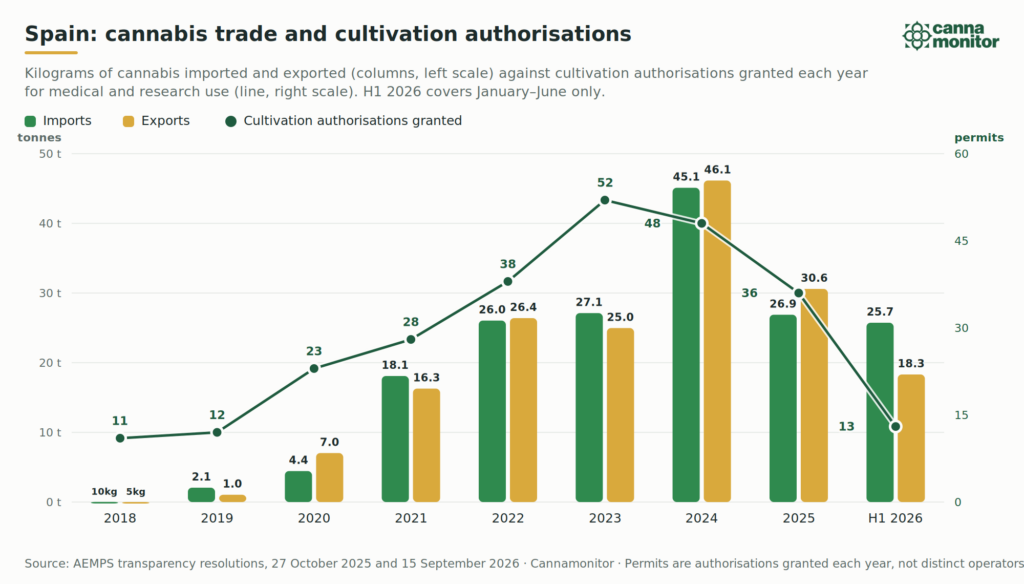
The geography confirms it. Across 2024, 2025 and the first half of 2026, AEMPS lists twenty countries of origin and destination, from Colombia, Thailand and Canada to Jersey, Mauritius and Ukraine. A country supplying its own patients does not need that map.
The licensing line runs the other way. Cultivation authorisations for medical and research use climbed from 11 in 2018 to 52 in 2023, then fell to 48, 36 and 13 in the first half of 2026 — the permit peak arrived two years before the tonnage peak, and fewer new entrants are now carrying more volume. Spain also authorised 19.6 tonnes of production for medical purposes in 2025 against 26.9 tonnes imported: even as a producer country, it buys in more than it licenses itself to grow, because processing capacity, not cultivation, is what the export trade sells.
None of these figures describe a Spanish patient. That number is counted elsewhere, and it is counted in single digits.
Thirteen applications from five laboratories, two products approved, both Curaleaf's
| 13 → 2applications received, preparations registered | 5laboratories behind the thirteen files | 30 daysshelf life, against 1–3 years of stability data |
Royal Decree 903/2025 created the register of standardised cannabis preparations — the only legal route by which such a preparation reaches a Spanish patient. Since it opened, AEMPS has received 13 applications from five laboratories. One was withdrawn, ten are pending, and two are registered, both of them Curaleaf’s, manufactured through its Spanish arm Medalchemy. The other four applicants are not identified in the disclosure, and not all of them necessarily hold a Spanish footprint; the decree registers the preparation, not the postcode.
Standardised cannabis preparations: 13 applied, 2 registered

The shape of the pipeline matters as much as its length. Six of the 13 candidates are balanced THC:CBD preparations, most at 10 mg/ml of each; four are THC-dominant, at 25 or 150 mg/ml; three are CBD-dominant. They cluster tightly on the oils set out in the standard formula, and there is no flower among them. Approve all thirteen and Spain still has a formulary of oils in a handful of ratios — with no inhaled presentation, which clinicians consider the missing tool for acute pain, where an oil taken by mouth acts too slowly to be useful.
One parameter shapes everything downstream of approval: the prepared product carries a 30-day shelf life, while stability data on the underlying preparations runs to one to three years. Thirty days turns supply into monthly batches, monthly hospital visits for patients who may live two hours from the pharmacy that prepares them, and stock a hospital cannot hold in advance. Extending it is the single cheapest intervention available to the system, and it requires no new product at all.
The register can widen in the other direction too. New monographs in the National Formulary would enlarge the set of preparations that may legally be made — new ratios, new routes of administration, eventually the inhaled presentation — and that route runs through the health ministry rather than through any company’s dossier. Meanwhile the decree’s own six-month clock means the ten open files must resolve, or lapse, over the coming months.
But approve every one of them tomorrow and a Spanish patient’s odds barely move. The constraint sits past the register, inside the hospital.
Hospitals are writing their protocols to dispense
| 353hospital pharmacy services, each its own adoption decision | 22,231community pharmacies, if collaborative dispensing generalises | 6autonomous communities piloting that model |
Preparations under the decree are prepared and dispensed by hospital pharmacy services. There are roughly 353 of them, and each one is effectively its own adoption decision: a pharmacy and therapeutics committee, a protocol to draft, a purchasing route to open, a workflow to agree between the prescribing specialist and the pharmacist who will make up the preparation. Spain’s medical cannabis market will be won or lost hospital by hospital, and that is a slower and more fragmented campaign than any regulatory milestone.
Money is the first friction. There is no new line of funding attached to the decree, so the cost lands on the prescribing department’s existing budget, weighed against every other claim on it. A department that adopts cannabis is choosing to spend money it already had, on a therapy whose evidence base its own clinicians are still learning — and prescriber training remains thin, particularly outside the indications the decree names: oncology, neurology, palliative care and spasticity, with chronic pain, the largest pool in every comparable market, left largely outside.
Scale is the second. Preparing standardised cannabis takes trained staff, validated processes and a patient volume that justifies both, and most Spanish hospitals will not have that volume for some time. The realistic near-term map is a handful of large centres in Madrid and Catalonia, which means access will be determined by which autonomous community a patient lives in before it is determined by their diagnosis. Territorial inequality is the most likely first-order outcome of this roll-out, and it is the one worth measuring from the start.
The structural answers are already in motion, if slowly. Collaborative dispensing — the hospital keeping prescribing control while a community pharmacy hands the medicine over — is being piloted in six autonomous communities, with a legal challenge over Sativex and Epidiolex dispensing running in the background; if it generalises, the number of places a patient can collect from moves from 353 towards Spain’s 22,231 community pharmacies. Widening the National Formulary would do for the product range what collaborative dispensing does for the map.
Data sources and limitations
Sources. AEMPS — transparency resolutions of 27 October 2025 and 15 September 2026, disclosed to Cannamonitor (cultivation applications and authorisations, authorised area and production, imports and exports, denied and withdrawn applications, origin and destination countries, and the register of standardised preparations under Royal Decree 903/2025). Infarmed — Portuguese export data, H1 2026. Consejo General de Colegios Oficiales de Farmacéuticos — community pharmacy count, 2024. Cannamonitor analysis — ratio grouping of the thirteen candidate preparations, run-rate calculations, and supply-chain attribution. Industry and clinical observations from Farmaforum, Madrid, September 2026.
Limitations. H1 2026 covers six months; any annualised figure is labelled as such and is not reported data. AEMPS lists countries of origin and destination as a single combined set across 2024–H1 2026, without splitting origins from destinations or breaking them down by year. The agency states that it holds no data on how many hospital pharmacy services have acquired standardised preparations, so dispensing activity is not a regulator-published figure. Authorised cultivation figures are permits granted each year, not a count of distinct licence-holders.