

Portugal shipped 66.3 tonnes of medical cannabis in six months — world #2, behind only Canada. A Portuguese patient can choose from three or four flower strains, at roughly twice what a German pays, on a salary a third the size.
Portugal exported 66,305 kg of medical cannabis in the first half of 2026 — 83% of its entire 2025 total, in half the time — while the number of licensed entities fell from 49 to 43 and Infarmed ran 32 inspections in six months. The enforcement wave did not shrink the trade; it concentrated it. But the destination data complicates the victory: Germany’s direct share fell from 72.9% to 56.5%, and almost all of the apparent diversification went to Spain and Denmark, jurisdictions that process and re-export rather than consume. Counted properly, the share of Portuguese exports ultimately bound for Germany rose from 87.1% to 88.0%.
Portugal shipped 66.3 tonnes of medical cannabis in six months — world #2, behind only Canada. A Portuguese patient can choose from three or four flower strains, at roughly twice what a German pays, on a salary a third the size.
That contrast is the shape of the Portuguese industry in 2026. It is an export business that happens to be located in Portugal, built on EU-GMP conversion capacity and a regulator with a reputation worth trading on, and it has just come through the most intensive enforcement year in its history with its volumes intact and its operator base smaller. What follows is what Infarmed’s H1 2026 activity reports, released on 20 August, actually show — and where the numbers stop supporting the industry’s preferred reading of them.
The enforcement year was also the record year
66.3 t exported in six months — 83% of all 2025 | 49 → 43 licensed entities, while volume rose | 32 inspections in H1 alone, annualising above 2025 |
Record exports, fewer operators — Portugal, 2022–H1 2026

Infarmed activity reports, 20 August 2026. H1 2026 covers January–June; the entity count is the register at 2 June 2026. The dashed block is the H1 run rate annualised, not reported data.
Operation Erva Daninha put the sector under investigation in May 2025 with 64 search warrants. Infarmed ran 57 inspections that year, up 50% on 2024, then 32 more in the first half of 2026 alone — a pace that annualises to 64. Cultivation authorisations fell 29%, from 38 to 27. The licensed-entity register went from 49 to 43.
None of it shows up in the export data. Portugal shipped 79,883 kg in 2025 and 66,305 kg in the first six months of 2026. Fewer licensed operators are moving more product than at any point in the industry’s history.
These are not two facts in tension. Compliance cost is a fixed cost, and fixed costs select for scale: the operators who could not carry the new reporting burden left the register, and the volume consolidated onto the ones who could. Laura Ramos, who has covered the sector since before it had an export market, describes exits as mixed — some genuinely bad actors, but also companies that “just couldn’t keep the investment or bankrupted.” Three years ago, more than 100 companies held pre-licences. That pipeline was never going to survive contact with a real compliance regime.
One detail is worth holding onto: 2025 was back-loaded, with 58% of the year’s volume shipped between September and December. A simple doubling of H1 2026 gives 132.6 tonnes. If the same seasonality repeats, that is conservative.
Germany’s share fell. Its exposure did not.
72.9 → 56.5% Germany’s direct share of exports | 87.1 → 88.0% once re-export hubs are counted | 43.9 → 12.0% genuine end markets, 2023 to H1 2026 |
Share of Portuguese cannabis exports by destination, 2023–H1 2026
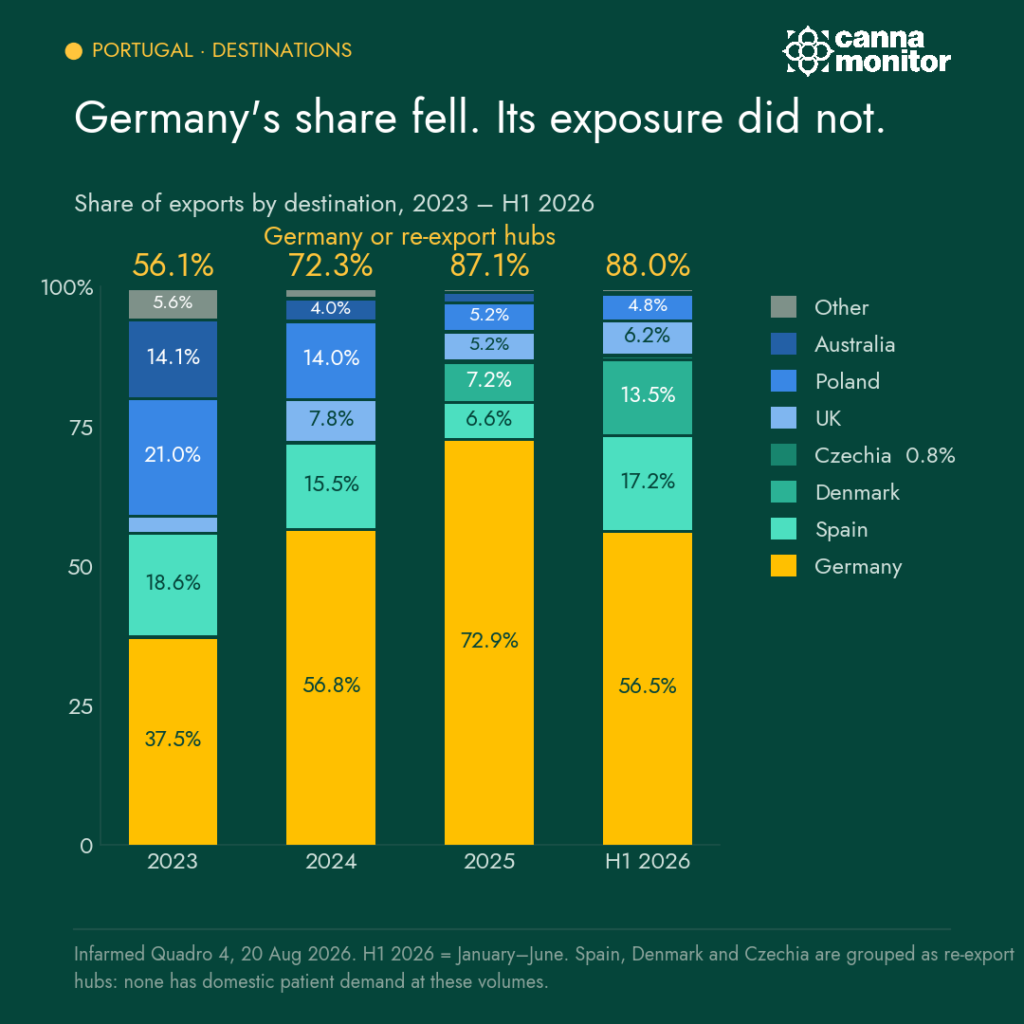
Infarmed Quadro 4, 20 August 2026. H1 2026 covers January–June. Spain, Denmark and Czechia are grouped as re-export hubs: none has domestic patient demand at these volumes.
Germany took 72.9% of Portuguese exports in 2025. By H1 2026 that was 56.5% — a sixteen-point fall that reads, at a glance, like the diversification the industry has been promising for two years.
Read the risers and it mostly is not. Spain went from 6.6% to 17.2%; Denmark from 7.2% to 13.5%. Neither absorbs that volume in patient demand. Spain’s hospital-only scheme is not operating and does not permit flower; Denmark’s registered products are not Portuguese. Both function as irradiation, decontamination and processing nodes — the flower moves through them, it does not stop.
Group them with Germany and the picture inverts. Portuguese exports bound for the German market, directly or through a hub that feeds it, went from 87.1% in 2025 to 88.0% in H1 2026. The concentration did not ease. It changed shape.
The genuine end markets tell the other half of the story. The UK, Poland, Australia and the long tail were 43.9% of Portuguese exports in 2023 and are 12.0% now. Poland alone fell from 21.0% to 4.8%; Australia from 14.1% to 0.3%. Over four years Portugal did not diversify away from Germany — it concentrated into Germany, and then distributed that concentration across three intermediaries.
A caveat we would rather state than bury. Infarmed has never disclosed Spain-bound irradiation volumes, and has declined repeated requests to do so. The hub grouping above is Cannamonitor’s inference from how those schemes operate, not a measured re-export figure.
The domestic market is finally moving, into a shelf that is not
+54% packs dispensed, annualised H1 2026 | 16 → 9 products approved vs actually on sale | 0 new approvals in 2026 |
Portugal’s approved products and packs dispensed, 2021–H1 2026
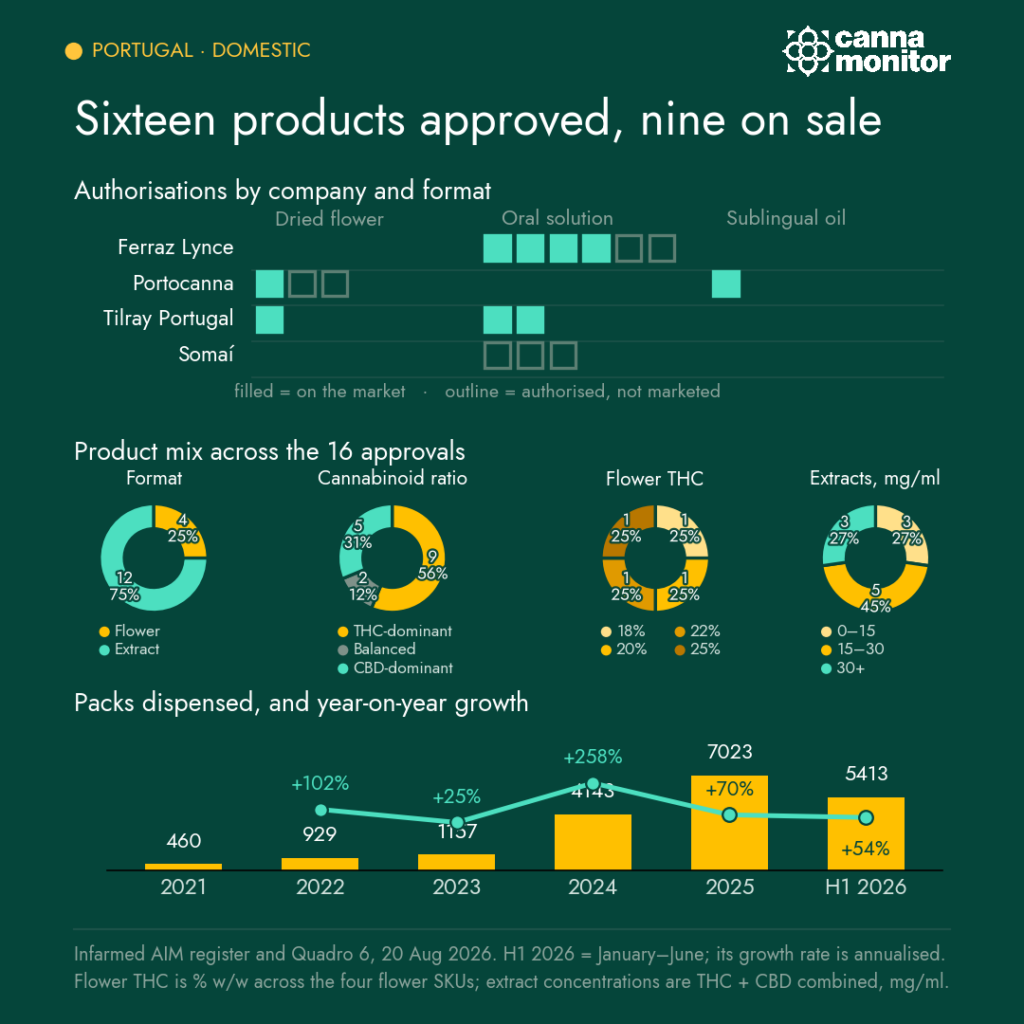
Infarmed AIM register and Quadro 6, 20 August 2026. H1 2026 covers January–June; its growth rate is annualised. Flower THC is % w/w across the four flower SKUs; extract concentrations are THC + CBD combined, mg/ml.
Packs dispensed in Portugal went from 460 in 2021 to 7,023 in 2025, and reached 5,413 in the first half of 2026 — roughly 54% annualised growth. After years in which the domestic programme was a rounding error against the export business, the demand curve has turned.
The supply side has not moved with it. Sixteen products hold an ACM; nine are actually on the market; there were zero new approvals in 2026. Four companies hold the entire catalogue, and one of them — Somaí, among the most visible EU-GMP manufacturers in the country — holds three authorisations and markets none of them domestically. Eleven of the sixteen approvals are oral solutions. Portugal exports flower by the tonne and offers its own patients two flower products.
The bottleneck is not registration. Law 33/2018 makes the Government responsible for educating health professionals about medical cannabis; that duty was never implemented. PTMC runs the training instead, targeting 25 doctors this year. Add pharmacy flower at €8.5–10/g against an average salary near €900 a month, with no SNS reimbursement, and the constraint is legible: patients are asking, and the system has not been built to answer them.
What to watch
The reset did not answer the question the industry thought it would. Portugal survived — comfortably, and with a stronger compliance record than before. What it has not done is change what it is: a conversion and re-export business whose economics are set in Germany, whose input is roughly half Canadian, and whose share of Canada’s European reprocessing has fallen from 100% to 64% in two years as Czechia and Malta scaled.
Three things decide 2027. Whether the register holds at 43 through the second-half renewals, or the consolidation runs further. Whether the hub share keeps rising, which would confirm that the diversification story is a routing story. And whether the domestic demand curve meets any new supply at all — because the one market where Portugal has no competitor is the one it currently does not serve.
Data sources and limitations
Sources. Infarmed — Medicinal Cannabis activity reports, 2025 and H1 2026, released 20 August 2026 (exports Quadro 4, prescriptions Quadro 6, authorisations, inspections, AIM register; operator counts as of 2 June 2026). Statistics Canada — Table 12-10-0121-01, HS 1211.90.10, monthly trade data through June 2026. CannaReporter® — H1 2026 Portugal reporting; Laura Ramos, Cannamonitor webinar, 27 August 2026. Cannamonitor analysis — hub grouping, corridor shares and EUR conversions.
Limitations. H1 2026 covers six months; annualised figures are labelled as such and are not reported data. The re-export hub grouping is Cannamonitor’s inference — Infarmed has not published Spain-bound or Denmark-bound routing volumes. Prescription counts include Sativex and Epidyolex, so they overstate flower and extract uptake. Pharmacy pricing and strain availability are from CannaReporter reporting, not regulator publications.