

In May 2026 the United Kingdom listed its first medical hash — Canadian-sourced static hash, crumble and ice-water hash — the clearest sign yet that concentrates are crossing from adult-use shelves into international medical markets. On our tracker that shelf is still gated by GMP-compliant supply, and price follows process, not potency: rosin holds a 30-40% per mg premium over the category average. This is the full read behind the headline: how the format matured abroad, what the numbers show, and why the premium is structural rather than a launch markup.
Table of Contents
Concentrates did not arrive on medical shelves overnight. They are a staple of legacy and mature adult-use markets, and the demand pattern — a premium, connoisseur tier patients already understand — was proven years before the first prescription. What is new is not whether concentrates sell, but which markets can legally stock them, and who is certified to supply.
Read alongside our data, the move looks less like a vapes-style format shift and more like a premium value migration: the shelf opens where GMP supply arrives, and price tracks novelty, scarcity and process economics rather than the potency on the label.
From legacy markets to pharmacy shelves
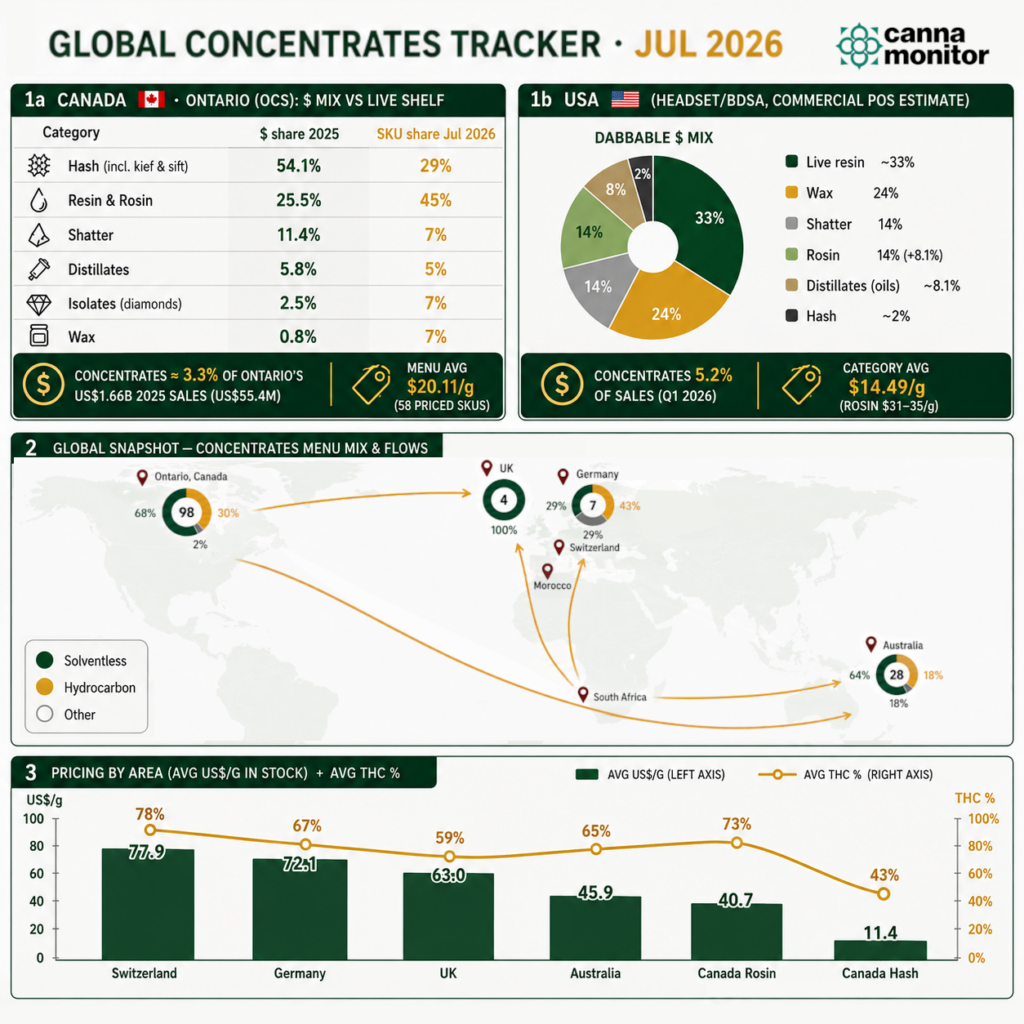
The medical shelf is the end point of a long adult-use maturation and a sudden burst of first listings. In the US and Canada, concentrates settle as a premium, connoisseur tier; familiarity, not novelty, drives repeat demand.
In North America, the category is not insulated from price compression, but premiums hold stronger than in the flower category, due to both scarcity and changes in the category mix towards more value-add concentrate types. The US category price falls about 34% ($21.86 → $14.49 EQ pricing) even as solventless rosin holds $31–35 per gram.
Concentrates stay niche at the counter — 5.2% of US sales and 3.3% in Ontario — yet traditional hash is half of Canada’s concentrate spend. Solventless rises against the trend: rosin reaches 14% of US dabbable value and grows +8.1% while other extracts decline.
A limited offering captures outsized premiums
Source: Cannamonitor hash & dabbable SKU tracker (137 SKUs, Jul 2026). Price panel uses priced SKUs on a common USD basis (small-n formats directional); shelf panel counts in-stock SKUs, with Canada shown as a mature-market benchmark.
In 2025, Germany saw the launch of the first concentrates in the market, anchored by DEMECAN live rosin offerings, which have been recently expanded to resin and distillate syringes for cartridge filling.
The United Kingdom saw the listing of its first hash SKUs in May 2026; while Australia is expanding into infused formats, with live-rosin vapes, gummies and oils broadening the appeal of new concentrate types.
The sequence is telling. The formats reaching medical markets are the ones adult-use demand had already validated — and the premium tier is leading the migration, not trailing it.
Across the main international markets our tracker covers, the shelf is thin and top-heavy. Australia carries the deepest catalogue at 27 in-stock SKUs; Germany holds seven and no traditional hash; the United Kingdom just three — against a mature Ontario benchmark of 98.
Pharmacies in other emerging medical markets like Switzerland and Poland carry or compound concentrate SKUs, which remain a niche, premium category.
The price panel inverts the potency intuition. Live rosin tops the shelf at about $51 per gram on roughly 73% THC, above diamonds at 86%. Price follows the cost of the process, not the cannabinoid count — the cleanest proof that concentrates represent a premium tier rather than another step in the potency race.
The emergence of concentrates in international markets represents a value migration from established offerings. While the category is likely to stay niche by volume — 5.2% of US sales — it can potentially capture a disproportionate margin share, especially as GMP supply remains constrained.
Pharma rules are the gatekeepers of mass access
What gates the category is supply, not demand. Germany’s seven-SKU, zero-hash shelf is not a verdict on patient appeal, but an example of the difficulties involved in setting up EU-GMP compliant supply chains. Where certified supply arrives — Australia — the shelf deepens and becomes more competitive, generating its own demand.
The premium is built into the value-add process and certification: unlike in the case of flower, the price ladder does not neatly track potency. The premium of formats such as live rosin looks structural and reproduces in mature markets, it’s not just a temporary scarcity markup. For prescribers and importers the differentiator is provenance and full-spectrum quality, not a higher number on the label.
Three things will decide how far the shelf opens:
- The first is the future of ready-made extracts for inhalation and suitable medical devices. Where quality, abundant, dose-metered vapes exist, the need to access concentrates might be reduced.
- The second is conducive regulations allowing to bypass the lack of pharmaceutical monographs to supply hash as an API for further manufacturing in magistral jurisdictions like Germany.
- The third is supply corridors — with countries like Morocco and South Africa betting big on the future of the category as GMP-certified origins.
The wider backdrop is a premium category migrating market by market — proven in demand, waiting on certified supply to become the same staple it already is in legacy markets.