

The UK private medical cannabis market has scaled at a +113% CAGR through 2024. H1 2025 is tracking above 15 tonnes on Q2 run-rate. Behind the headline number, three structural shifts matter: growth rates are decelerating even as volumes still double, product mix is fragmenting beyond flower, and the binding constraints on further scaling are increasingly upstream. This analysis draws on NHSBSA private-prescription data for England (2019–H1 2025), and Cannamonitor’s clinic and importer mapping. The aim is to anchor where the UK market stands today against where it came from — and to name the bottlenecks that will decide who scales next.
Table of Contents
The UK programme began in late 2018 with the legal reclassification of cannabis-based products for medicinal use. Private prescribing took the load almost from day one and has compounded every year since. NHSBSA recorded 124,000 items dispensed in 2022, 283,000 in 2023 (+128% YoY), 655,000 in 2024 (+131% YoY) and 633,000 in H1 2025 alone — already 97% of full-year 2024 in six months, putting 2025 on track for roughly 1.27 million items (≈+93% YoY). The dosage-form mix has held remarkably steady at the top: flower remains ~83–84% of dispensed items, oral liquid sits at 9–12%, while vapes have moved from 2% to 5% and oral solids from 2% to 3% between 2024 and H1 2025. Item volumes compounded at a +130% CAGR from 2022 to 2024, and the H1 2025 step keeps that doubling pattern intact for a fourth consecutive year — the cleanest compounding curve of any European medical cannabis market.
Volume: from 1.9 to 15+ tonnes, and still doubling
The headline trajectory has held for four years. Flower monthly run-rate moved from 158 kg in 2022 to 333 kg in 2023 (+111% YoY), 717 kg in 2024 (+115% YoY), 850 kg in Q1 2025 (+19% annualised vs 2024) and 1,370 kg in Q2 2025 (+91% annualised; +61% QoQ).
On Q2 run-rate, England is on a 15+ tonne flower sell-out trajectory in 2025. The items-level series tells the same story: 124,000 items dispensed in 2022, 283,000 in 2023 (+128%), 655,000 in 2024 (+131%), and 633,000 in H1 2025 alone.
Q1’s softer print gave way to a sharp Q2 reacceleration, which reads more like an import-batch and prescriber-onboarding artefact than a demand ceiling. Growth is not over: flower remains the main supply engine of the British market, and the doubling pattern has held for four consecutive years.
England — Flower Dispensing and THC Trend

Dosage forms: flower loses share for the first time
England — Items Dispensed by Format

For the first time since the launch of the programme, flower has lost market share — falling from 84% of dispensed items in 2024 to 83% in H1 2025 — despite growing +50% on a monthly run-rate basis. Vapes (+182%) and pastilles (+131%) simply grew faster; oils and tinctures lagged at +27%. Behind the share crack sits a cannabinoid mix that is increasingly format-specific: in H1 2025, flower is 97% THC-dominant, vapes 88% THC-dominant, oral liquids 56% Balanced and oral solids 77% Balanced.
Inhalables and orals are diverging into two distinct cannabinoid worlds — high-THC for fast-onset use, Balanced and CBD-led for sustained dosing. The absolute share crack is small, but operators have been waiting for it: it is the first measurable evidence that the UK programme is fragmenting beyond its founding flower monoculture, and that demand for advanced dosage forms is no longer a thesis. A 1-point share move on a doubling base is a strategic inflection, not a wobble — and on current run-rates flower’s share will keep ceding to vapes and pastilles through 2026.
Potency: high-THC wins, but inflation is slowing
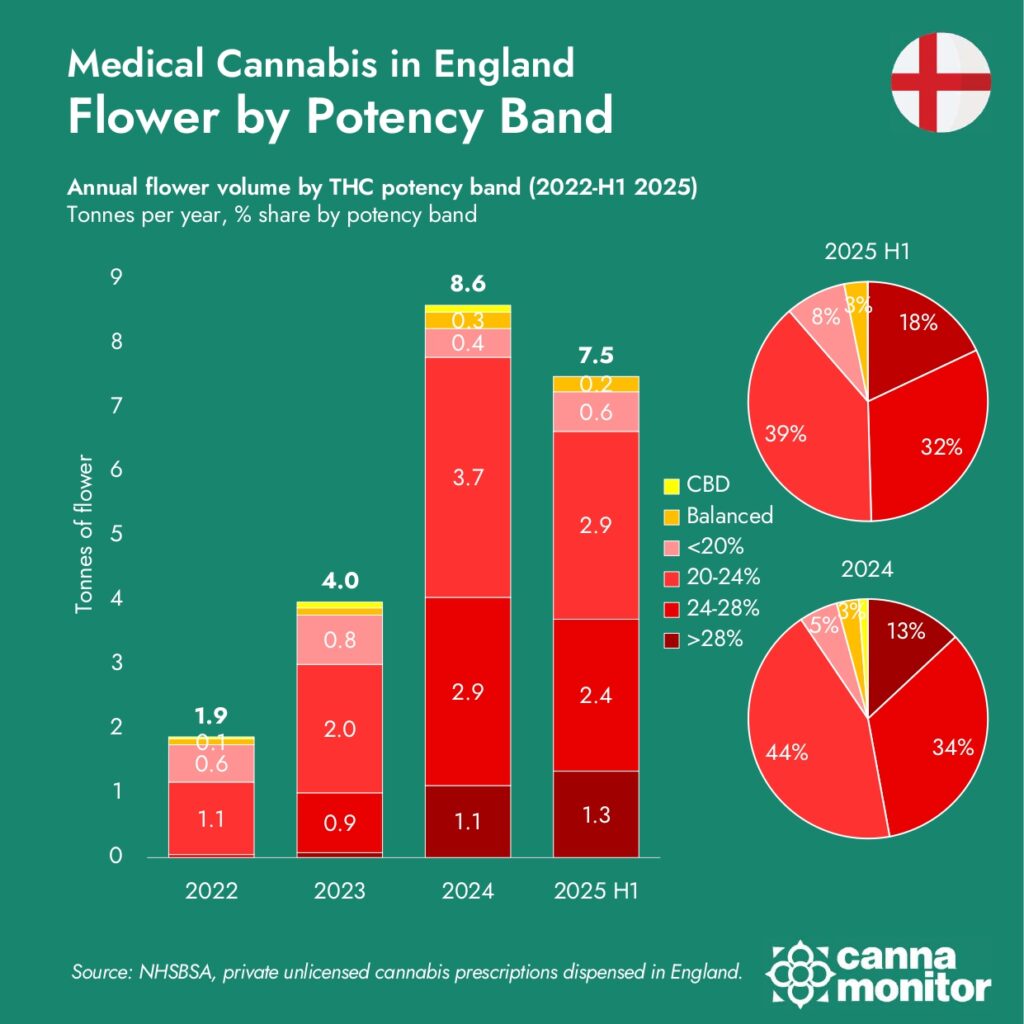
The story inside flower is similarly nuanced. The potency mix has tightened: >28% THC rose from 13% of flower items in 2024 to 18% in H1 2025, 24–28% slipped from 34% to 32%, the long-dominant 20–24% band fell from 44% to 39%, and <20% THC rebounded from 5% to 8%.
Growth came predominantly from the high-potency tier, expanding at the expense of the 20–24% band — but the re-emergence of low-potency flower, particularly through smalls and popcorns at 20% THC or below, has partly offset the high-end push. The average high-THC potency line has nonetheless continued to climb, from 20.3% in 2022 to 23.8% in H1 2025. The cultivar split is moving with it: in H1 2025, Hybrid leads at 43%, Indica at 38% and Sativa at 19%, with Sativa run-rate growing fastest (+71%).
The “high-THC race” is real, but budget SKUs and broader cultivar variety are pulling the lower end back into play — and the simple “potency keeps rising” line no longer captures the picture.
England — Flower Dispensing by Potency
Beyond flower: vapes triple, pastilles double
England — Dominant Cannabinoid by Format

Vape volumes roughly tripled in H1 2025 against a current panel of approximately 40 SKUs across ~10 brands, with the product set widening to include distinct device types and Resin/Rosin extractions.
Pastilles remain a Curaleaf monopoly in the wake of Columbia Care’s and Althea’s exits — but the category is unlikely to stay single-supplier for long, given the pace of regulatory and clinical reception.
Ointments, pessaries and suppositories round out the dosage-form long tail.
The most strategically meaningful signal sits underneath the format split: the first products engineered around complex cannabinoid profiles, including added minor cannabinoids, are now arriving.
Formulation is becoming a real differentiator — not just device choice or packaging — and the operators investing in cannabinoid-profile R&D today will define which dosage forms scale through 2026.
Prescribers: online clinics drive the funnel, super-prescribers anchor it
NHSBSA data shows 314 unique prescribers over the period, with 166 active in H1 2025. The base has expanded from 17 prescribers in 2019 to a peak of 201 in 2024, with the H1 2025 active count reflecting the seven-month window rather than attrition.
Concentration is easing but still narrow: a single prescriber still accounted for roughly 10% of all prescribed items — over 9,000 per month — though that share is down from a 50% peak in 2019. The top-5 prescribers’ combined share has collapsed from 81% to 27% over the same window, and items per active prescriber have risen from ~2,440 in 2022 to ~6,530 in H1 2025 — so individual caseloads are scaling even as concentration eases.
The funnel is broadening at the front and narrowing at the back — and that asymmetry, with clinics consolidating patient acquisition while prescribers fragment, is now the defining shape of the UK market.
England — Prescriber Base and Concentration

Outlook: volume growth is the easy part
The UK medical cannabis market is doing three things at once: scaling, diversifying and concentrating. Doubling has held for four years; vapes and pastilles are reshaping the dosage-form mix from a flat 84% flower base; potency, cultivar and cannabinoid-profile choices are diversifying inside every format; and a small set of online clinics funnel demand into a still-narrow prescribing core.
The winners of 2026 plan for competition, not the trend line. That means earning share in the high-growth advanced-dosage segments before they consolidate, building formulation depth as minor-cannabinoid SKUs land, and either operating the clinic gate or partnering tightly with whoever does. Supply credibility — import-licence throughput, MHRA specials capacity, GMP-aligned manufacturing — will increasingly decide which operators can convert clinical demand into delivered product.
Volume growth is the easy part. The infrastructure that supports it — formulation, prescriber relationships, supply credibility — is what will separate the next cohort of UK-relevant operators from the rest.
Sources: NHSBSA (private CBPM prescriptions, England 2022–H1 2025); Cannamonitor SKU matching. Items ≠ volume, value or patients. NHSBSA covers private hand-written prescriptions dispensed in England (84% of UK population); H1 2025 = January–July (seven months); processing lags mean items can still surface for prior periods; transcribing and attribution errors are likely given the manual nature of reporting.