

Ten Dutch municipalities have spent nine months under a rule no other European market has tried: their coffeeshops may sell only cannabis from licensed growers. Ten comparison municipalities carried on under the ordinary toleration policy. Researchers of the first follow-up measurement report photographed the menus of 134 shops across both groups, in 2022 and in 2025, and counted what was on them. Those menus listed roughly 11,000 items, more than double the 4,800 recorded at baseline.
Table of Contents
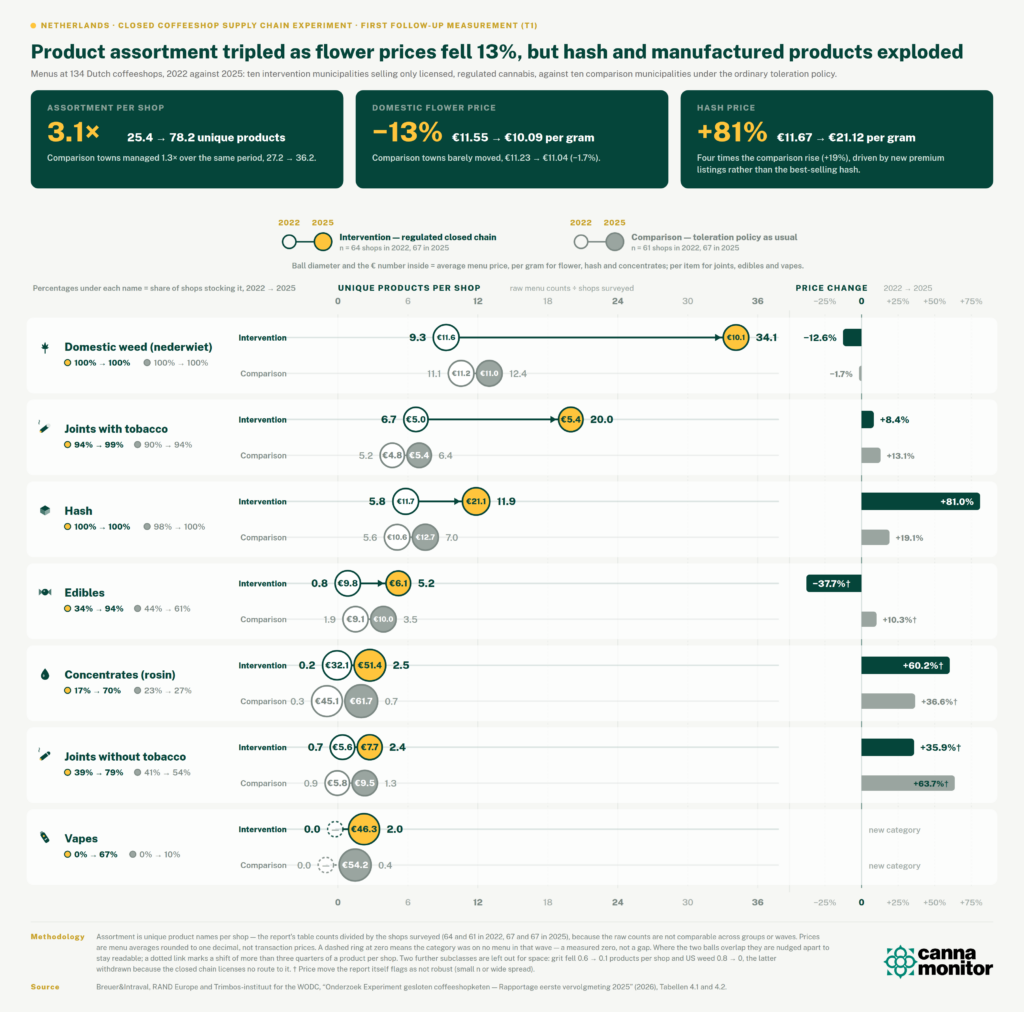
The average intervention coffeeshop carried 25 unique products in 2022. It now carries 78 — 3.1 times as many. Comparison shops went from 27 to 36 over the same period, a rise of 1.3 times. The gap is not marginal; it is the difference between a shop that restocked and a shop that was rebuilt.
How the Shelf Changed Under the Experiment
Flower drove most of it, from 9 references per shop to 34. Joints went from 7 to 22, hash from 6 to 12. But the steepest moves were in categories that barely existed. Concentrates appeared on 17% of intervention menus in 2022 and 70% now. Edibles went from 34% to 94%. Vapes went from nothing at all to 67%. In the comparison towns the same formats reached 27%, 61% and 10% respectively — the same direction, a fraction of the distance.
One number runs the other way, and it is the most revealing in the study. Across all 134 shops, the count of distinct product names fell, from roughly 3,100 to 1,750. Ten licensed growers now ship large batches of the same strain, under the same name, to shops in every participating municipality. Each shop’s range expanded while the country’s range contracted — a national assortment that behaves like a retail chain rather than a set of independents.
Domestic flower in intervention shops fell from €11.6 to €10.1 per gram. In the comparison towns it did not move: €11.2 to €11.0. The intuitive explanation is buying power from consolidated supply, and the intuitive explanation is wrong.
The report’s grower interviews give a different mechanism. All ten licensees are operational, producing steadily larger volumes, and are approaching overproduction — which is already creating price pressure. Regulated supply overshot regulated demand inside the first year. That is a licence-design outcome, not evidence that regulation is inherently deflationary, and any jurisdiction sizing licence rounds against a fixed retail footprint should read it as the base case rather than the exception.
Hash went the other way: €11.7 to €21.1 on the menu, against €10.6 to €12.7 in the controls. Quoted alone, that 81% rise is the most misleading number in the report. It is a menu average, lifted by new premium Dutch-made listings entering the top of the range. The best-selling hash — what most buyers actually leave with — moved from €10.0 to €10.7, around 7%. In the comparison towns it fell.
Product assortment and prices per format in the supply chain experiment
What the experiment has not yet solved
Most public-health indicators did not move differentially. Frequency of use, self-rated health, the share of visitors screening at elevated risk on the CAST, and quality-of-life ratings near the shops all held steady, the last at 7.6 to 7.8 out of 10. The authors are careful to say the exposure window is too short to establish absence of effect either way.
Two things did move. Grams per weed purchase rose significantly more in intervention towns, where five grams overtook one gram as the most common transaction at 30% of purchases; in the controls, one gram still leads. And the average quantity per illicit hash transaction rose significantly in intervention municipalities while falling in the comparison group.
That second finding is the uncomfortable one. Regulated hash is dearer on the menu, narrower in choice — the share of intervention hash buyers reporting insufficient choice doubled, from 11% to 23% — and rated worse by the people buying it. Constrained regulated supply appears to have fed the illicit hash trade rather than displacing it, in exactly the municipalities where regulated hash is mandatory.
There is a counterweight. THC percentages now appear on 57% of intervention menus against 15% of comparison menus, and growers report buyers beginning to choose on potency rather than on strain. Several of those growers would prefer a coarse mild-to-strong indicator instead — a regulatory design decision with a measurable behavioural outcome, and one the supply side is already asking to revisit.
Three questions carry into the second wave. Whether the flower price floor holds once growers adjust output to real demand, or whether overproduction corrects and prices drift back. Whether regulated hash closes the gap on variety and price, given that full enforcement only began in September 2025 — T2 will be the first measurement of a properly closed hash market. And whether the illicit hash signal proves temporary, as the authors suggest it may.
Nine months is a short window, and the researchers describe every finding here as an interim snapshot. The full breakdown — per-shop and per-stocking-shop SKU tables for all 15 subclasses, the complete price series, and the difference-in-differences coefficients — is available in Cannamonitor Decide.