


CBD is emerging as the industry’s most contested category — squeezed between reclassification proposals, EU novel-food handovers and credibility-damaging testing scandals — even as medical cannabis frameworks mature into a different fight: not whether patients can access product, but under what conditions and who pays for it. Import-dependent supply chains are colliding with trade-defence and domestic-production politics.
Key figures from June 2026 include:
- Germany‘s legal sourcing rose from 23.5% to 88.4% post-Cannabis Act
- Canada pre-rolls overtake flower as largest category at C$1.43bn (34%)
- Brazil cannabis import permits hit 23,199 in March (+60.1% YoY)
- UK medical SKUs double to 818 in a year: avg flower falls to £6.80/g
- Israel‘s new dumping case cites C$1.91/g export price vs C$4.03/g domestic
- Switzerland‘s Zürich pilot registers 117,800 sales for 1,001 kg since 2023
- Morocco covers 140+ registered products across 600+ points of sale
- Thailand gov claims cumulative exports reached 202 tonnes, ฿2.566B ($71M)
- Spain‘s Cannabis Club Systems breach exposes ~985,000 member IDs
- Cyprus finds 88% of sampled CBD products mislabelled
Feel free to contact us at info@cannamonitor.com with any suggestions.
New Datapack:
Unlock the Full Cannabinoid Trial Pipeline 

Behind Exilby, the first high-THC, full-plant pharmaceutical
Cannamonitor’s latest free datapack breaks down the clinical R&D landscape that made it possible — phase by phase, formulation by formulation, country by country — and tracks the programmes lining up to follow. Access it now.
 Regulation
The DEA opened its Schedule III rescheduling hearing backing reclassification. Germany‘s Bundestag holds hearing on a bill to strip dried flower from statutory reimbursement. The UK‘s FSA moved to hand CBD novel-food authority back to the EU. Brazil‘s ANVISA let compounding pharmacies produce cannabis derivatives, but review of RDC 660 puts import route in doubt. Australia‘s TGA tightened advertising rules, closing plant-medicine loophole. Czech PM proposes reclassifying CBD as a drug precursor and cutting the hemp THC limit to 0.3%. Thailand opens review to relist cannabis as a narcotic. Israel reopens anti-dumping case against Canadian imports.
 Market
US markets opened to plant-touching operators: Trulieve and Glass House uplisted to the NYSE. Exilby’s approval in Germany opens a €400m pharma opportunity. Canada’s top producers posted record earnings as CanadaBis and Entourage entered insolvency. UK medical SKUs doubled to 818 in a year. New Zealand‘s Ora Pharm bought Helius out of administration to form the country’s largest cannabis company. Switzerland‘s CanLeg pilot won federal approval, planning 5,000 participants.
 Science
Lancet review links commercial cannabis, but not decriminalisation, to higher use and disorder.
New Datapack:
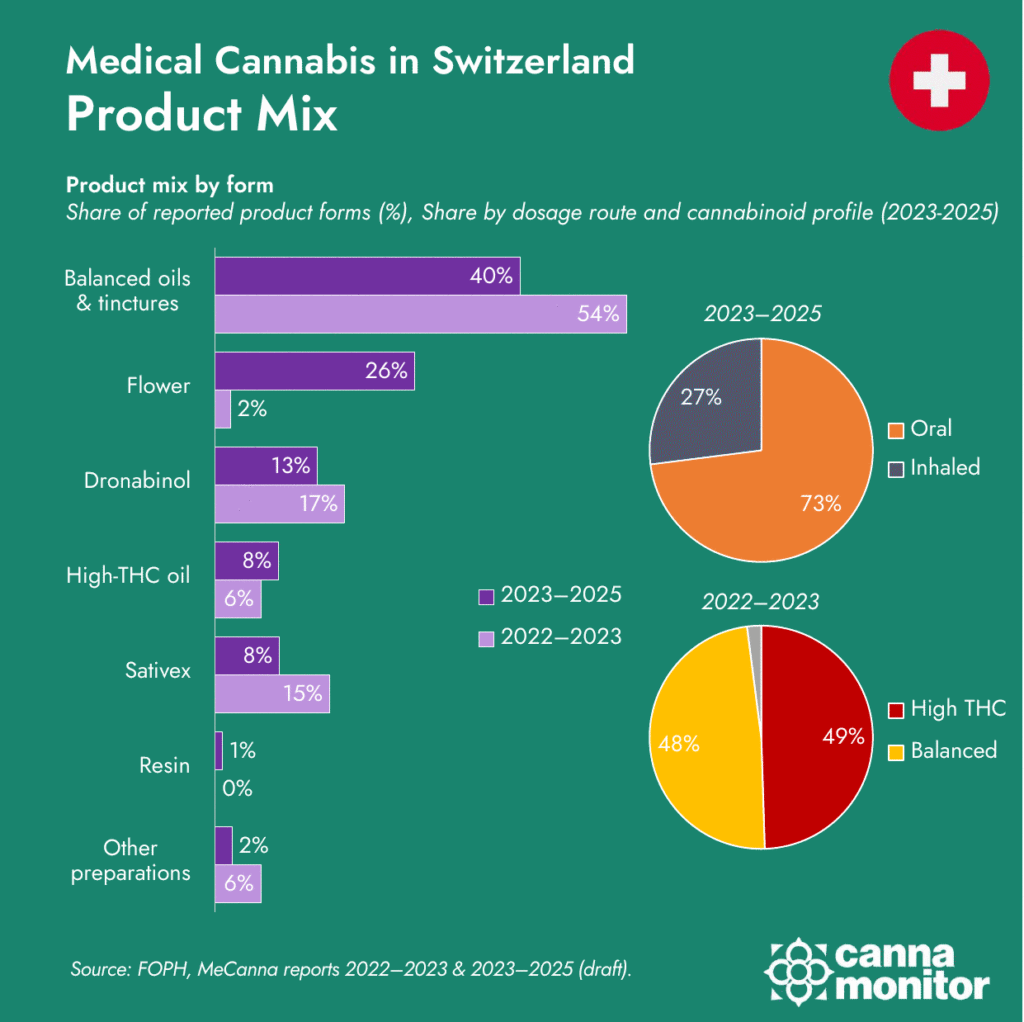
Medical Cannabis in Switzerland
 USA — DEA opens Schedule III rescheduling hearing as first plant-touching operators list on the NYSE
 On the radar: the DEA’s Schedule III hearing runs 29 June–15 July, with a judge’s recommendation and final DEA rule to follow; the 12 November hemp redefinition to 0.4 mg total THC per container remains scheduled as House-delay and White House replacement efforts compete; Massachusetts votes on adult-use repeal in November.
Regulation — Rescheduling reaches its decisive hearing amid a barrage of court challenges
The DEA came out backing Schedule III at its rescheduling hearing opening on 29 June, its counsel telling the tribunal the government “supports” the proposed reclassification, not merely proposes it — the most consequential federal drug-reform proceeding in over 50 years.
- The government’s case turns on proving a currently accepted medical use (CAMU):
- FDA scientist Dominic Chiapperino testified that the 10-month FDA/HHS review found credible therapeutic benefit — strongest for neuropathic pain across 39 trials — and lower abuse and dependence potential than Schedule I–II drugs.
- A binding 2024 DOJ legal opinion locks in the two-part CAMU test, barring opponents from relitigating the standard — though several tried on cross-examination.
- The proceeding is structurally one-sided: the judge set a two-week schedule to 15 July while the DEA invited only seven anti-rescheduling parties.
- Those seated include SAM, NDASA, the Tennessee Bureau of Investigation, the states of Nebraska, Idaho, Indiana and Louisiana, and two physicians; reform supporters were ruled not “adversely affected or aggrieved” and denied standing.
- With no pro-reform participants, the DEA alone defends the rule, backed by Chiapperino and a pain-medicine physician as its two witnesses.
- Three consolidated challenges in the D.C. Circuit seek to stay and vacate the rule before its expedited registration deadline, with standing the pivotal hurdle.
- A three-state petition from Nebraska, Indiana and Louisiana (22 May) alleges the Acting Attorney General breached the Administrative Procedure Act and exceeded Controlled Substances Act authority; Louisiana has since sought to withdraw, leaving Nebraska and Indiana.
- A motion to stay from drug-testing body NDASA and pharma developer MMJ asks the court to freeze the rule before it takes effect, arguing a 1977 precedent bars rescheduling without the required HHS medical review and notice-and-comment; NDASA cites ~$700,000 in member costs as irreparable harm.
- A third petition from five “aggrieved persons” (28 May) rounds out the consolidated case: addiction clinic New Directions, physicians Kenneth Finn and Elizabeth Stuyt, victims’ advocacy group CIVEL, and pharma developer MMJ.
- They ask the court to stay, declare unlawful and vacate the order, pressing 13 issues — from an unauthorised “hybrid” federal schedule to APA notice-and-comment failures and the loss of §280E tax relief for state operators.
- MMJ has enlisted former DEA officials, including a retired DEA section chief and a Harvard addiction expert, to argue the rule rewards state operators while penalising FDA/DEA-compliant pharmaceutical developers.
The SAFE Banking Act returned to Congress, reintroduced with American Bankers Association backing to protect financial institutions serving state-legal operators.
A separate Supreme Court ruling handed reform a constitutional tailwind, striking the federal gun ban as applied to cannabis consumers in United States v. Hemani.
The White House intervened on the looming hemp cliff, pressing Congress to replace or delay the 12 November redefinition — a 0.4 mg total-THC-per-container standard that would strip roughly 95% of hemp-derived THC products from shelves.
- The Congressional Research Service set out the legal mechanics of the redefinition and its one-year implementation delay.
- The National Restaurant Association urged a delay and a national framework for hemp-THC beverages.
- Minnesota’s THC-beverage breweries are flagged as early casualties of the ban.
California reshaped licensing in the largest US market, adopting an emergency rule (effective 4 June) that lets dual medicinal-and-adult-use licensees split into separate Medicinal (M) and Adult-Use (A) licences.
- Crucially, the split can be granted on an expedited basis and issued to a different legal entity than the current holder — opening the door to restructuring, asset separation and cleaner M&A across California’s operator base.
- California proposed track-and-trace safeguards against “lab-shopping”, requiring all parties to approve a transfer before a shipping manifest can issue, plus retailer tax entry and Certificates of Analysis on request (comment to 20 July).
- California also proposed group plant-tagging (to 27 July) to cut cultivator costs by tagging plant groups rather than individual plants, while preserving inspector reconciliation.
- Montana set 1 July compliance changes: mandatory exit-packaging warnings and a 5 mg THC per-serving cap for ingestibles.
State expansion advanced on multiple fronts. The headline move was Virginia’s budget deal to open adult-use retail from 1 July 2027.
- New markets and higher limits widened elsewhere:
- Illinois signed the SB 3222 omnibus, doubling possession limits while curbing intoxicating hemp.
- Minnesota enacted an omnibus law unifying its supply chain and adding a macrobusiness licence.
- Vermont doubled possession to two ounces and enabled interstate-commerce compacts.
- Access and equity measures moved in three states:
- Rhode Island scrapped residency rules and revised social-equity criteria.
- New York overhauled its medical programme via S3294-A.
- Connecticut signed a tribal compact with the Mashantucket Pequot Tribe.
- Eastern states opened new fronts:
- Alabama made its first legal medical sale in Montgomery.
- Pennsylvania Democrats filed a discharge resolution to force a floor vote on SB 120, as analysts separated the rejected SB 49 bill from the HB 2309 hemp-beverage bill.
- New Jersey’s S-4297 retail-conversion bill drew a League of Municipalities veto request.
- Texas Original launched the state’s first medical-marijuana vaporisation device, expanding delivery-method options within Texas’s restrictive medical programme.
Massachusetts cleared a path to a November 2026 adult-use repeal vote, after its top court upheld certification of the repeal petition.
- Louisiana’s adult-use pilot bill died as the governor signed a school-zone felony law recriminalising possession near schools.
- Washington, D.C. operators warned a proposed medical sales-tax hike could push a fragile market over the edge.
Market — The NYSE opens to plant-touching operators, reopening institutional capital
Trulieve opened the NYSE to plant-touching cannabis, listing as TRLV on 10 June as the first US operator on the exchange.
- Glass House followed, applying to uplist and deconsolidating its dual-use business before winning approval to trade as GLAS from 30 June.
- Enabling moves multiplied: Verano approved a 1-for-5 reverse split and TerrAscend closed an oversubscribed US$21.7m debenture ahead of its own uplisting.
- Curaleaf’s Boris Jordan mapped a path to institutional capital; analysts weighed which MSO uplists next.
- M&A and financing accelerated, with Viridian counting ~US$1.97bn across 40 Q1 deals.
- Operators reshaped their balance sheets:
- Cresco closed a US$50m revolving credit facility with Needham Bank.
- Trulieve authorised a US$50m share buyback.
- AYR transferred its NJ, Florida and Nevada operations to Arboretum.
- A lender merger flagged for review aims to widen capital access for cannabis businesses.
- Operators reshaped their balance sheets:
Legal states crossed a cumulative adult-use tax milestone, surpassing US$28.4bn in revenue even as growth cooled.
- Demand and labour signals were mixed: A 2026 jobs report showed New York employment doubling as national sales dipped on price compression.
- New Mexico drew notice for a quietly successful market built without hype.
- Ascend Wellness workers staged the first US grow-house strike at Barry, Illinois.
- Operators managed exposure and risk: Curaleaf launched a Spanish-language retail programme across 73 Florida dispensaries.
- BRĒZ restructured its hemp-THC beverage business, seeking a US$15–20m raise.
- A Nefos data breach exposed roughly 985,000 member IDs, including about 30,000 US users.
Science — PTSD cohort and a Phase 2 withdrawal trial headline the month’s evidence
A retrospective cohort tied medical cannabis to sharply lower acute-care use among PTSD patients, linking it to 35.6% fewer urgent-care and 35.1% fewer emergency visits across 1,946 patients, with adverse events in under 2%. A separate US study found medical cannabis laws reduced health-related workplace absenteeism by 6.9%, adding labour-market evidence to the debate over the policy’s broader economic effects.
- Clinical trials sent mixed signals, led by PleoPharma’s Phase 2 CAN-002: its high-dose arm cut withdrawal irritability 43% versus placebo, advancing PP-01 as a potential first-in-class once-daily oral treatment for cannabis use disorder. PleoPharma then dosed its first patient in a pivotal Phase 3 trial of PP-01, moving the programme a step closer to a potential FDA-approved cannabis-withdrawal treatment.
- A Phase I study found CBD co-administered with alcohol produced no significant acute effects in moderate drinkers.
- A systematic review judged THC evidence in inflammatory bowel disease inconclusive: four small RCTs (n=180), all high risk of bias, showed no consistent benefit on remission, disease activity or quality of life.
- Pre-clinical work mapped two mechanisms, most notably CBD restoring REM sleep to healthy levels (2.75%→4.82%) and cutting spontaneous seizures in an Angelman-syndrome mouse model.
- A rat study found cannabinoid abstinence generalised stress responses via astrocyte atrophy and raised enzyme activity in the nucleus accumbens — a male-specific effect the authors tie to PTSD/cannabis-use-disorder comorbidity.
A pricing study showed legal cannabis undercuts the illicit market only in mature states, beating illicit prices in Colorado, California and Michigan but not newer markets such as Massachusetts and Connecticut (median illicit $7.10/g in recreational states vs $8.90/g elsewhere).
- Product-surveillance research flagged a regulatory headache: Leafly-review data show reviewed strains rose 13-fold, from 280 (2010) to 3,905 (2023), with hybrids and >20%-THC strains growing fastest.
- A New York survey exposed weak label literacy: 77.4% of consumers misidentified the required state symbol (only 37.9% picked it correctly) and about half never check the Certificate of Analysis.
- Public-health studies quantified spillovers, led by a Pennsylvania quasi-experiment: bordering a recreational-legal state drove a 58% rise in marijuana-positive crash reports in affected counties.
- An International Cannabis Policy Study analysis of 281,533 people found frequent and problematic use concentrated among cisgender men, transgender men and transgender women across Canada and the US.
 Germany — Exilby wins Europe’s first marketing authorisation for a cannabis painkiller as reimbursement-killer bill reaches Bundestag
On the radar: Exilby’s free-pricing period ends at September launch, triggering G-BA benefit assessment and GKV negotiation that could delay reimbursement 2–3 years; Hesse GMP tightening narrows the “GACP abroad, finish in Germany” import model; Hemp Association lawsuit vs Bavaria’s de facto cultivation ban.
Regulation — Reimbursement bill reaches its Bundestag hearing to cut dried flower from cover
A draft bill reached its Bundestag hearing on 22 June, seeking to strip dried cannabis flower from statutory reimbursement (§31(6) SGB V; draft 21/6130) — the government’s most active June step in a wider push to rein in a fast-growing medical-cannabis channel.
- The medical-cannabis association BDCan opposed the removal (statement 18 June), warning it would harm severely ill patients and that projected savings are unproven, and calling for grandfathering plus quality controls.
- A parallel draft MedCanG amendment — requiring in-person prescribing and banning mail-order of flower — did not advance in June (no reading since the January committee hearing); the SPD and parts of the Union have signalled they will not back it as written.
- The push follows an H1-2025 import surge of over 400% (roughly 19 to 80 tonnes) against single-digit GKV-prescription growth, which the health ministry casts as misuse of the medical channel.
- Associations warn of supply gaps, while legal experts argue that restricting German doctors while EU telemedicine platforms stay free breaches EU free-movement law.
Hesse’s health regulator tightened GMP rules for medical-cannabis flower from 8 June, requiring GMP-compliant drying and trimming at the place of harvest — the month’s biggest compliance shift for importers.
- The change narrows the common “GACP abroad, finish in Germany” import model: batch release stays with the Qualified Person (§14 AMG) even when partial manufacture occurs abroad under non-GMP regimes.
- Flowers must meet Ph. Eur. 5.1.8 Category B microbiology unless inhalation is excluded, and imports now need a §72a AMG certificate per third-country supplier plus a GACP/GMP process scheme, with existing permits facing a GAP-analysis review.
A Cologne administrative court upheld the ban on commercial cannabis-cuttings sales, ruling hydroponic cuttings count as cannabis plants under the Cannabis Act (23 June), closing a supply loophole for cultivation associations.
- The Freiburg regional court separately acquitted CBD retailer Green Brothers over industrial-hemp flowers (30 June), finding the THC thresholds were not exceeded — the first significant post-MedCanG CBD-flower acquittal.
Interior ministers softened Hesse’s drive against cannabis clubs, with the 225th IMK rejecting a public-use ban and a club freeze (19 June) while backing lower possession limits (25 g in public, 50 g at home) and restored investigative powers.
- Hesse municipalities reported few fines but persistent confusion over cannabis exclusion zones, suggesting enforcement of the possession-distance rules remains patchy even as interior ministers debate tightening them nationally.
- Germany will begin recording cannabis-impaired driving accidents in official federal statistics, closing a data gap that has fuelled debate over the Cannabis Act’s road-safety impact.
- The Hemp Association and CSC Inntal sued Bavaria over its building-law block on cultivation associations (3 June); the state has approved just three and demands special zoning that exists nowhere in it — a de facto cultivation ban.
- Bavaria’s health minister Judith Gerlach called on the federal government to fully reverse cannabis legalisation around World Drug Day (26 June), keeping Bavaria the most vocal state opponent of the Cannabis Act.
- Two CSU Bundestag MPs visited Canify’s Leipheim site (18 June) to discuss documentation burdens and workable framework conditions for reform.
Market — Exilby’s launch opens a near-€400m pharmaceutical opportunity as supply competition intensifies
Exilby’s marketing authorisation opens a near-€400m reimbursed pharmaceutical opportunity, with Krautinvest modelling €387m annual potential (10m chronic-back-pain patients at €38.69 per unit).
- The AMNOG pathway means free pricing for 6 months, then a G-BA benefit assessment and GKV negotiation; failure to agree could delay reimbursement 2–3 years after the August/September launch.
Weed argued pharmacy margins should be cut instead of ending flower reimbursement, citing a ~28% fall in flower prices to about €5/g, private-market pricing at €4.99/g, pharmacy reimbursement of €13–19/g, and German-grown supply at €4.30/g.
- Tilray Medical Germany launched ARX, its first premium brand cultivated in-market, with EU-GMP production at Aphria RX in Neumünster and national distribution via CC Pharma and 14U Pharma.
Avextra launched a balanced THC/CBD cannabis granulate for pharmacy-compounded capsules, giving pharmacists a standardised starting material for individual 2.5 mg and 5 mg THC/CBD formulations, including feeding-tube administration.
- Pharmacies can source it directly; wholesale distribution is expected from late summer, extending the product to hospital and long-term-care channels.
- Supply entrants from multiple geographies deepened competition — Suprobion (S-LAB) made the first Polish medical cannabis export to Germany, a 7-strain debut batch.
- Cannava signed a granulate export deal with NOC PHARMA.
- Seed Junky Genetics partnered with Green Success Group to launch three flagship strains in Germany and the UK.
- Neural Therapeutics won shareholder approval to acquire CWE in a 12 June transaction update, renaming to Hanf.com Inc.
- Berlin hosted a week of B2B summits and the Mary Jane Berlin festival (9–15 June).
Science — Germany grants Europe’s first marketing authorisation for a cannabis-derived non-opioid
Germany granted Europe’s first marketing authorisation for a cannabis-derived non-opioid painkiller, with Exilby authorised on 9 June for chronic radicular low-back pain — backed by over 1,200 Phase III patients, including an 820-patient placebo-controlled RCT that met its primary endpoint.
- Launch in Germany and Austria is set for September 2026; approximately 18m opioid prescriptions are written annually in Germany.
- A US pivotal Phase III is underway, with a read-out expected in 2027 and an NDA in 2028; the FDA granted Breakthrough Therapy Designation on 18 May 2026.
- Forbes profiled Exilby as ‘the world’s first cannabis-based painkiller’ (9 June).
A survey of 11,471 German cannabis users found legal sourcing rose sharply after the Cannabis Act, jumping from 23.5% to 88.4%.
- Home cultivation (49.0%) and pharmacies (29.2%) were the main legal channels; dealer use fell to 4.7%; adolescent sourcing was unchanged.
- A separate study examined mental-health risk profiles for problematic cannabis use in Germany.
 Canada — Top operators post record earnings while weaker rivals collapse into insolvency
On the radar: Israel’s anti-dumping case against Canadian medical-cannabis imports has responses due 29 July, with a preliminary decision expected in August or September. CanadaBis Capital Phase 1 bids are due 15 July and Entourage Health bids 30 July. SNDL still faces divestiture or licence risk in Ontario.
Regulation — Ontario targets retail control while Israel reopens the import fight
The Alcohol and Gaming Commission of Ontario moved chain consolidation from market backdrop to active enforcement risk, with an investigation finding SNDL held de facto control of 46 Ontario cannabis stores despite the province’s 25% producer-ownership cap.
- AGCO told SNDL it could avoid contested proceedings only through a genuine, complete divestiture; otherwise the regulator could revoke licences for Spirit Leaf Ontario and Superette Ontario and stop processing new retail applications or transfers tied to them.
- The case lands as the Retail Cannabis Council of Ontario pushes to raise the provincial store cap from 150 to 300, a move critics say would accelerate chain concentration in a market that already has more than 1,700 licensed stores.
Alberta’s move to consignment shifted inventory and cash-flow risk back onto producers even as demand kept migrating toward convenience formats, showing how the market’s structural pressure now sits below the headline earnings winners.
- Alberta Gaming, Liquor and Cannabis set out a phased move to consignment distribution, with Connect Logistics remaining central in phase two before private warehousing expands in phase three.
- Under the proposed model, producers move from being paid in about 15 days to getting paid only when product sells; Cannara Biotech and Decibel Cannabis saw upside for efficient operators, while Everest Cannabis warned of cash-flow strain and slower-moving inventory risk.
Health Canada recalled about 5,000 Arizer Solo III Intergalactic portable vaporizers, citing fire and burn hazards from an electrical short (18 June).
- Consumers were told to stop using the product immediately and contact 7111495 Canada Inc. for a free replacement.
Israel’s Commissioner of Trade Levies opened a second anti-dumping investigation into Canadian medical-cannabis imports, restarting a trade fight the courts had buried six months earlier (29 June) and threatening the export outlet Canadian producers increasingly need.
- The complaint was backed by about 15 Israeli growers, who argue imports rose 33% in value from $40.7m in 2023 to $54.2m in 2025.
- The filing alleges a 125% dumping margin, based on an average Canadian export price of C$1.91/g versus a domestic Canadian price of C$4.03/g; responses are due by 29 July and a preliminary decision is expected in August or September.
Cannabis Council of Canada suspended active operations after membership fell to 18 members and four affiliates, symbolising how even sector-wide advocacy could no longer fund itself.
Market — Record survivors consolidate while insolvencies and consignment shifts expose the weak
Pre-rolls overtook flower as Canada’s largest cannabis category at C$1.43bn and 34% share in 2025, while the Nova Scotia Liquor Corporation reported C$138.8m in FY2025/26 cannabis sales, up 9.3% year on year. One industry estimate put Nova Scotia’s illicit cannabis market at C$60–140m against that C$138.8m in legal sales, suggesting the unregulated channel may still rival the legal one even years after legalisation.
Canada’s strongest operators widened the gap on earnings and balance-sheet resilience, with Aurora Cannabis reporting record FY2026 medical revenue of C$288.6m and adjusted EBITDA of C$53.8m, Canopy Growth returning to top-line growth in Q4 and FY2026, and High Tide posting record Q2 revenue of C$179.3m and adjusted EBITDA of C$13.9m.
- Aurora Cannabis ended the year with about C$164.7m in cash and no debt, even as management guided FY2027 revenue below the FY2026 record.
- Canopy Growth finished FY2026 with C$131.3m in net cash and positive adjusted EBITDA as its FY2027 target after the MTL Cannabis acquisition helped lift Canada medical revenue 27% in Q4.
- High Tide paired Canadian retail scale with a growing medical-distribution arm in Remexian Pharma, which generated C$31.6m in segment revenue on 7.6 tonnes distributed.
- Nextleaf Solutions reported Q2 FY2026 net revenue of C$2.4m at a 38% gross margin, a smaller extraction-focused operator holding steady margins even as larger peers post the year’s bigger swings.
- Village Farms announced a US$15m registered direct equity investment from institutional investors, adding fresh capital alongside its Canadian cannabis and Dutch cultivation operations.
Consolidation spread through acquisitions, court-supervised restructurings and institutional retreat, as better-capitalised groups bought distribution, patient access and brands while weaker operators entered sale processes or shut down their advocacy platform.
- Tilray Brands acquired HelloMD‘s Canadian medical-cannabis assets, adding telehealth and patient-engagement infrastructure to its domestic medical platform.
- High Tide agreed to acquire four Northern Helm stores in Ontario for C$7.74m, taking Canna Cabana to 228 locations nationally and 103 in Ontario.
- Emblem Cannabis closed its C$5.5m CCAA acquisition of Ayurcann, adding 90+ SKUs and a licensed Pickering manufacturing site.
- Vireo Growth and C21 Investments announced a definitive arrangement agreement, the latest cross-border tie-up as operators consolidate scale rather than compete as standalone platforms.
- CanadaBis Capital launched a court-approved sale and investment process while carrying C$7.6m in CRA excise arrears, C$4.2m in secured debt and C$4m in unsecured convertible debentures.
- Entourage Health opened its own court-supervised sale process after entering CCAA with roughly C$240.1m owed to its senior lender and 53 staff already cut from the adult-use wind-down.
Provincial retailers and distributors kept adjusting store networks, labour terms and product lineups beneath the headline consolidation story.
- Newfoundland and Labrador opened a tender for up to 15 new Tier 4 cannabis retail locations, with applications closing 4 July 2026.
- Ontario Cannabis Store workers ratified a new agreement, avoiding a strike that would have disrupted the province’s wholesale distribution.
- SQDC launched SQDC Pro, a subscription analytics tool for Québec’s cannabis market, giving retailers and producers new sales and trend data.
- Village Farms‘s Pure Sunfarms launched a Pink Kush Cured Resin 510 vape, targeting Canada’s fastest-growing product category.
- Canopy Growth‘s Claybourne brand won Best Infused Pre-Roll for its Frosted Flyers at the 2026 Grow Up Awards.
Science — Clinical evidence advances faster than public understanding of cannabis risk
A Canadian aggregate N-of-1 trial found medical cannabis extracts produced clinically meaningful symptom relief in cancer care, with 50 of 89 participants improving versus placebo across eight cancer centres.
- THC, CBD and 1:1 extracts all outperformed placebo on patient-reported change, but no single formulation worked best for everyone, supporting personalised prescribing.
- Sleep, tiredness and anxiety drove much of the benefit; a starting dose of 2.5 mg three times daily was well tolerated, while moderate or severe adverse effects were rare and mainly associated with THC.
Population research suggests legalisation has not closed Canada’s knowledge and risk-pattern gaps, with health-literacy gains remaining modest and consumption patterns still diverging sharply by gender identity.
- A repeated cross-sectional survey of about 93,933 Canadians found no overall improvement in the composite Health Knowledge Index from 2018 to 2023; awareness remained highest for impaired-driving risk (79–81%) and lowest for psychosis risk (34–38%).
- A Canada-US analysis of 281,533 respondents found daily use was about 14% among cisgender men, transgender men and gender-diverse respondents, while reported medical use among past-year consumers was highest among gender-diverse respondents at 64%.
 Brazil — ANVISA widens formal access as domestic production starts to catch Brazil’s import-led cannabis boom
On the radar: Any ANVISA move on RDC 660 could redefine the import route that served 47% of Brazil’s 672,000 medical-cannabis patients in 2024. SNCR testing for electronic yellow and blue prescriptions could ease telemedicine prescribing. The new STJ/STF coverage line will keep pressure on courts and patient associations.
Regulation — ANVISA clears compounding pharmacies to produce cannabis as top courts curb insurer coverage
ANVISA let compounding pharmacies produce derivatives under a revised RDC 327 — June’s most consequential move, opening a domestic manufacturing route instead of leaving supply dependent on imported finished products.
- The revision keeps the CBD-dominant model and confines THC above 0.2% to palliative use in irreversible conditions, while individual imports under RDC 660 are left untouched.
- The same package added a supervised production sandbox under RDC 1.014 — ANVISA‘s first experimental route toward a Brazil-specific cultivation-and-manufacturing model.
- It also tightened special-control rules under RDC 1.011, extending them to cannabis inputs and veterinary products and clarifying how THC concentration sets a product’s classification.
Brazil’s top courts narrowed when health plans must pay for cannabis, with the Superior Court of Justice (STJ) and Federal Supreme Court (STF) limiting mandatory health-plan coverage on 23 June.
- Insurers need not supply products without ANVISA registration or medicines for home use, leaving patients dependent on a fragmented lower-court map.
- Against that, a federal court in Paraíba widened association access to medicinal flower, letting new ABRACE Esperança members obtain flower for vaporisation on proof of membership, a medical report and a current prescription.
The next access fight is over RDC 660, the import route behind 47% of Brazil’s 672,000 registered patients in 2024, with a possible RDC 660 review gaining momentum.
- Clinicians and patient groups warn that repealing it would cut access to cannabinoids beyond the CBD-heavy pharmacy shelf.
- Separately, ANVISA began testing electronic controlled prescriptions — the yellow and blue forms — through the SNCR, easing a bottleneck for telemedicine prescribers.
- Brazil and Uruguay held an institutional exchange on medicinal-cannabis regulation, comparing regulatory approaches as both countries continue to expand access frameworks.
- Enforcement gaps also showed, with brands marketing cannabis products online outside ANVISA’s rules.
Market — Record import demand is feeding a turn toward domestic pharmaceutical production
Record patient demand is funding a shift from access-by-import to local pharmaceutical industrialisation, with March import permits hitting 23,199 — up 60.1% year on year — and more than 61,000 authorisations granted in Q1 2026.
- The same import-driven market is now projected at about R$1bn in 2026, with anxiety (38.5%), chronic pain (25.4%) and insomnia (13.5%) the main treatment drivers cited in the June reporting.
- FarmaUSA Life Science imported one tonne of cannabis extract to build a 100%-Brazilian API route for the compounding-pharmacy channel.
- Semeya, the pharmochemical arm of Grupo Ease Labs, secured ANVISA’s CBPF certification for cannabis API manufacturing, reducing reliance on imports and formalising a domestic input supplier.
Brazilian operators are moving from imported finished goods toward regulated local formulation, with Ease Labs and Endogen both trying to widen pharmacy access through domestic or lower-cost product formats.
- Ease Labs said it will produce Brazil’s first nationally manufactured hard capsule, using FAPEMIG backing to build a regulated oral product that could reduce import dependence.
- Endogen reformulated its cannabis portfolio with Cellera Farma, launching four higher-concentration CBD oils and shifting sourcing from Switzerland to Colombia to cut cost per milligram by up to 50%.
Groups with regulatory depth are now building Brazil-first pharmaceutical platforms rather than one-off product lines, with GreenMed using the country as its main regional growth engine.
- GreenMed said it already has one ANVISA-registered product plus an active pipeline, supported by commercial commitments in Brazil above USD 100m.
- The company’s pitch is vertical integration plus certification depth — GMP, CBPF, and a pending EU-GMP process — allowing it to supply APIs, finished medicines and high-THC flower into regulated export markets from a Brazil-centred expansion strategy.
 Australia — TGA enforcement tightens as the market shifts from access growth to compliance, consolidation and clinical proof
On the radar: The My Health Record consultation closes on 7 July and the ODC remaking consultation runs until 19 July, so Canberra’s next move could formalise tighter oversight of telehealth prescribing and cannabis licensing. The final shape of the NSW driving bill will show whether patient-protection reform can expand even as federal enforcement hardens.
Regulation — TGA’s advertising crackdown closes the ‘plant medicine’ loophole and clinic-to-prescription funnels
The TGA tightened medicinal-cannabis advertising rules, cracking down on the clinic-to-prescription funnels and ‘wellness’-style branding that had become the sector’s biggest promotional loophole.
- The updated TGA guidance says euphemisms such as “plant medicine”, medicinal-cannabis branding in logos, and clinic marketing that functions as a route to a prescription can all amount to unlawful advertising; enforcement examples cited include three infringement notices totalling A$56,340 and a A$13,320 practitioner fine.
- In the same enforcement climate, Montu was accused of deleting Slack and Miro records during discovery in the Federal Court advertising case.
- The TGA also restated prescriber duties for unapproved products, reminding doctors that most cannabis goods remain unapproved under the SAS and AP pathways, requiring documented consent, active monitoring and 15-day adverse-event reporting.
The ODC opened a licensing-rules consultation, reviewing whether to renew or amend the Narcotic Drugs Regulation 2016 before its 1 April 2027 sunset.
- The consultation runs 22 June to 19 July, covering cultivation, manufacture and licence-charge rules.
New South Wales became the first Australian state to break the automatic driving-ban model for prescribed patients, with the Road Transport Amendment (Medical Cannabis and Driving Offences) Bill 2026 introduced to Parliament.
- Unrestricted-licence patients who register with Transport for NSW and complete the education programme could avoid penalties if laboratory THC is below 50 ng/mL; first and second above-threshold detections trigger warnings, while a third within two years brings a A$704 fine and a minimum three-month suspension. Around 300,000 NSW patients are covered and the scheme is due for review after one year.
- NSW also dropped a proposed medicinal-cannabis exclusion from workers-compensation rules, preserving reimbursement for prescribed treatment.
- NSW also launched a Hemp Industry Development Plan targeting a A$100m low-THC sector by 2032, pairing its medicinal-cannabis reforms with a parallel push to grow industrial hemp.
- Queensland scrapped its own driving-law review and kept a zero-tolerance THC ban, leaving patients without a prescribed-use defence despite the state accounting for about 45% of national medicinal-cannabis prescribers.
Market — Consolidation is accelerating, but brands and growers are still racing up the value curve
The market is consolidating at the top even as weaker economics start to show through, with Little Green Pharma completing its merger with Cannatrek while Montu and Triniti illustrate the pressure on high-growth clinic-era models.
- The LGP–Cannatrek combination creates a vertically integrated Australia–Europe operator spanning cultivation, manufacturing, distribution and clinics, with former Cannatrek holders owning about 60.5% of the enlarged group.
- Montu reported A$569m in revenue and A$15.5m in after-tax profit over an extended 18-month period, but the visible June takeaway was slower growth and rising costs approaching A$300m as Australia’s domestic medicinal-cannabis market cools.
- Triniti Holdings entered a payment-terms dispute after its December acquisition, showing that not every telehealth asset is cleanly converting early growth into stable ownership outcomes.
At the same time, producers and investors are still building capacity and pharmaceutical-style platforms for the next stage of the market, from cultivation scale to corporate repositioning.
- Austranna said its automated Mutdapilly site could double Australia’s growing capacity, pairing a five-hectare cultivation footprint with 8,500 m² of GMP manufacturing space.
- Bioxyne rebranded to BLS Pharmaceuticals and consolidated its share base, a capital-markets signal that medicinal cannabis operators still see value in presenting themselves as pharmaceutical platforms rather than pure cannabis plays.
- In adjacent hemp infrastructure, New South Wales awarded A$10m to Ausuntech and Murray Industrial Hemp for fibre-processing and hempcrete capacity, showing public capital still backing cannabinoid-adjacent manufacturing buildout.
Competition is also moving up the brand and product ladder rather than just chasing commodity volume, with premium genetics, new delivery formats and internationally recognised names entering the channel.
- Khalifa Kush entered Australia through an Endoca partnership, bringing an established global brand into pharmacies and clinics nationwide.
- Altermedic launched a solventless live-rosin range, including what it described as Australia’s first nano-emulsified live-rosin gummies.
- ECS Botanics launched 23% THC Gelonoidz #20 under its Terphogz strategy, signalling a deliberate move from price-led volume into premium branded flower for both domestic and export demand.
Science — Sydney trial shows high-dose CBD eases spinal-cord-injury pain, while a 1,656-dose study maps real-world benchmarks
A controlled efficacy signal for high-dose CBD in neuropathic pain, with a Sydney-led randomised trial finding that oral CBD titrated to 800 mg/day reduced spinal-cord-injury pain versus placebo.
- In the 38-patient crossover study, pain scores fell to 3.82 on CBD versus 4.36 on placebo, with 37.8% of participants achieving at least 30% pain relief versus 11.1% on placebo.
- The effect size was modest rather than transformative, but it gives Australia one of June’s cleaner cannabinoid efficacy datasets and supports follow-on clinical work rather than another purely observational claim.
Australia’s real-world evidence ecosystem is also getting more operational, with an OnTracka analysis of 1,656 dose events across 317 patients proposing practical review benchmarks for clinicians.
- Nearly half of patients achieved at least one episode of ≥50% pain relief, while the analysis suggested symptoms can temporarily worsen around doses 3–5, dose 10 is a natural review point, and doses 20–40 are the best window for assessing whether treatment is working.
- That matters in a market where more than one million prescriptions have already been issued, but prescriber guidance still often defaults to “start low and go slow”.
The pipeline story was mixed rather than uniformly positive, combining one de-risking interim readout with one funding-driven setback.
- Avecho said its Phase III CBD insomnia trial cleared interim review and will continue to the planned 519 participants, with no serious adverse events across the first 244 participants.
- Nexalis Therapeutics suspended two cannabinoid-therapy studies after Linlithgo Family Office withdrew a A$52.3m funding facility, showing how fragile smaller clinical pipelines remain when capital support disappears.
 Thailand — Recriminalisation hardens even as the export channel keeps expanding
On the radar: Public hearings on the new cannabis-and-hemp bill are expected to run into late July, but June already showed the state’s direction of travel: domestic access is being pushed back toward tighter medical-only control, while the export channel is still being digitised and streamlined. The key question now is whether Thailand tries to preserve that split model or moves all the way back toward narcotics relisting.
Regulation — Recriminalisation momentum hardens while the medical-only system becomes more enforceable
June hardened the push to return cannabis to narcotics control, with an anti-drug network of doctors, academics and civil-society groups urging the government to relist the plant and the House Public Health Committee opening a formal review of whether cannabis should go back on the narcotics list.
- The anti-drug network cited Ministry of Public Health inpatient data showing cannabis dependence cases rising to more than 830 a month and cannabis-induced psychosis to about 556 a month — both around 6.5× above pre-liberalisation levels.
- It also pointed to cannabis-related hospital cases in tourist provinces rising to about 90 a month, with roughly 80% involving foreign visitors, arguing the 2022 unlock created a public-health and tourism problem rather than a manageable consumer market.
- The House Public Health Committee, chaired by Sakoltee Phattiyakul, then opened a broader policy review, with some lawmakers backing temporary relisting until a dedicated cannabis-and-hemp law completes its public-hearing process.
At the same time, Thailand’s legal channel is being pushed firmly into a medical-only framework rather than an open retail market, with regulators tightening the permitted route for sales and production.
- Regulatory summaries in June framed retail sales as increasingly limited to medical-only licensing channels, while cannabis and hemp extracts above 0.2% THC remain narcotics that can still be licensed for medical purposes.
- The Department of Thai Traditional and Alternative Medicine, the FDA and other health agencies are simultaneously working on a new cannabis-and-hemp bill meant to close loopholes left by the current controlled-herb model.
Enforcement then gained real operational teeth, as the Department of Thai Traditional and Alternative Medicine issued new penalty guidelines for licensed operators.
- Operators can face 30-day licence suspensions for failures involving Por Thor 27 and Por Thor 28 reporting, incomplete monthly reports, uncertified GACP exports or sales, licence-display failures, and advertising breaches.
- Suspensions can stretch to 90 days for export-notification failures or sales without a Por Thor 33 prescription form.
- Licences can be revoked for false reporting, sales to vulnerable groups, on-site consumption, online or vending-machine sales, or operating in prohibited areas such as temples, dormitories and public parks.
Market — The export economy is still growing even as the domestic regime tightens
Thailand’s commercial counter-story in June was not retail expansion but export-system formalisation, with the government moving cannabis export filings onto a digital platform even as domestic policy debates focused on recriminalisation.
- The Department of Thai Traditional and Alternative Medicine will connect DTAM Next with the Customs Department’s National Single Window, allowing operators to file the Por Thor 32 export form electronically instead of through paper-based processes.
- The government said cumulative cannabis exports have already reached 201,658 kilogrammes worth more than ฿2.5bn, showing that the state still wants a functioning regulated export channel even while tightening domestic access.
- Exporters currently submit around 100–200 forms a month, and the digital link is expected to cut processing time to 1–2 working days from 5–7 days, while reducing paperwork, forgery risk and operator travel costs.
That creates a clear split in Thailand’s market model: the domestic side is being pushed back toward medical-only control and possible recriminalisation, while the export side is still being streamlined as a legitimate commercial activity.
Science — A 10-patient Thai pilot tests cannabis oil during breast-cancer chemotherapy
Researchers at King Chulalongkorn Memorial Hospital tested cannabis oil during breast-cancer chemotherapy in ten women, a small but genuinely domestic randomised pilot.
- The 12-week study randomised 6 patients to cannabis oil and 4 to placebo, and while it was far too small to prove efficacy, it showed that this kind of cannabinoid gut–immune monitoring trial is feasible inside Thailand’s clinical system.
- The cannabis arm showed directional reductions in the proteolytic-fermentation marker iso-butyric acid and across several pro-inflammatory cytokines including IL-6, IL-8, IL-1β, TNF-α, IFN-γ, IL-12p70 and IL-17A.
- None of the endpoints reached statistical significance, so the paper is best treated as a hypothesis-generating domestic R&D signal rather than evidence strong enough to shape practice on its own.
Even so, the study matters strategically because it shows Thailand’s cannabis system still supports controlled medical research at the same time that policymakers are debating whether wider access should be rolled back.
 UK — Canada now supplies up to 80% of Britain’s cannabis, Europe’s biggest import-led market
On the radar: The ACMD‘s summer review will show whether ministers want to change the 2018 private-prescribing framework or keep watching from the sidelines. At the same time, the SPS reset could decide whether thousands of CBD products remain ordinary consumer goods or get pushed into a much narrower EU-style authorisation model.
Regulation — FSA set to hand CBD novel-food authorisations to the EU, leaving 12,000+ products in limbo
FSA is expected to hand CBD novel-food authorisations to the EU under SPS realignment, leaving more than 12,000 products tied to pending applications in limbo, with only a handful likely to clear before the handover.
- The Cannabis Trades Association then warned the FSA that dynamic alignment could push CBD toward a quasi-medicinal, pharmacy-only model, after six years of a novel-food process that still has not delivered a fully authorised consumer market.
- The risk is not just delay but a harder end-state: EFSA is working with a proposed 2 mg/day intake threshold versus the FSA‘s provisional 10 mg/day, raising the prospect that alignment would not just slow the sector but materially narrow the shelf-access model that UK CBD businesses built around.
Parliament confirmed that the ACMD will examine whether the 2018 CBPM framework has had the desired effect, including whether private prescribing has reduced incentives to run clinical trials for NHS-suitable products.
- The ACMD report is due in summer 2026, with DHSC, NHS England and the MHRA all observing the working group.
- In parallel, the Home Office declined to expand cannabis-specific policing powers, arguing that the existing anti-social-behaviour toolkit, closure powers and standard Class B enforcement remain sufficient.
Market — UK cannabis SKUs double to 818 in a year as competition drives prices down
A report projects more than 140,000 UK patients in 2026, as Canadian producers now supply an estimated 70–80% of the market, available SKUs more than doubled in the last year from 374 to 818, and competition pushed average flower prices down to £6.80/g and vape prices down by about 25%.
- Against that backdrop, Curaleaf Laboratories partnered with Herdade das Barrocas to reintroduce HDB products to the UK, using Portuguese cultivation plus UK MHRA-approved manufacturing and distribution.
- Tilray issued 1.61 million shares to fund its Lyphe acquisition and retire US$6m of debt, reinforcing the logic that patient access, prescribing, pharmacy and supply need to sit inside one integrated UK platform.
The UK is also attracting new branded and genetics-led entrants: Seed Junky Genetics partnered with Green Success Group to enter the UK and Germany, bringing flagship US genetics into regulated medical channels rather than leaving the UK as a pure white-label import market.
 Northern Leaf scaled Jersey exports as the island’s medical-cannabis sector turned its first profit, with the company projecting revenue growth from about £6m in 2025 to £10m in 2026.
 By contrast, Peel NRE withdrew its £100m Isle of Man cannabis complex after a four-year planning impasse, showing that capital still exits quickly when infrastructure, utilities and economics fail to align.
Science — A UK-led Lancet review ties commercialised legalisation to higher use and cannabis-use disorder
University of Bath researchers tied commercial legalisation to higher use in a Lancet Psychiatry review, finding that non-medical commercial markets in Canada and the USA raised adult cannabis use, cannabis-use disorder and potency across 2000–2025.
- The review also linked commercialised markets to more hospital admissions for psychosis, but found no consistent rise in the prevalence or incidence of psychotic disorders.
- By contrast, strictly regulated supply and decriminalisation across Europe, Africa, Oceania and Asia showed weaker or no associations with use or psychiatric harm.
Ananda Pharma completed its Phase 1 MRX1 study and reported a favourable tolerability profile ahead of two Phase 2 programmes — ENDOCAN for endometriosis pain and ACTION for chemotherapy-induced peripheral neuropathy.
- The study dosed 20 healthy volunteers across 2.5 mg/kg and 7.5 mg/kg twice-daily regimens, plus a fed-condition arm, with only mild treatment-emergent adverse events and no clinically significant laboratory abnormalities.
A University of Liverpool fNIRS study found no clear inhibitory-control differences across cannabis-risk groups across 81 participants.
- The study found no significant differences in stop-signal response times or prefrontal activation during a cannabis-cue task.
 France — Medical-cannabis generalisation finally gets a timetable as CBD enters a legal squeeze
On the radar: July’s promised regulatory texts will show whether France can finally turn years of medical-cannabis extensions into a permanent framework, even if first prescriptions under that system still look unlikely before 2027. In parallel, the Conseil d’État fight over the DGAL CBD-food crackdown will test whether Paris is really targeting public-health risks or simply making the legal hemp market harder to sustain.
Regulation — France advanced toward medical-cannabis generalisation even as it tightened pressure on CBD foods
France’s long-delayed medical-cannabis generalisation finally got a concrete political timetable, with the health minister telling AFP that the regulatory texts are due in July.
- UIVEC confirmed the reimbursement decree for cannabis-based medicines had been finalised in mid-June, cleared by the Ministry of the Economy, and was being transmitted to the Conseil d’État on 30 June.
- Minister Laurent Panifous told the Sénat the text would be examined after the summer break, with publication announced for the autumn (la rentrée).
- The July texts are the gateway to the next stages of the permanent framework, including the HAS reimbursement opinion and the ANSM product-registration path, even if first prescriptions under the generalised system are still not expected before 2027.
- The stakes are concrete: since the 2024 reclassification, patients already enrolled in the 2021 experiment remain covered, but for lack of a published text no new patient can enter the scheme, leaving those in therapeutic impasse blocked while they wait.
French industry bodies including UIVEC, UPCBD and AFPC moved to challenge the DGAL control plan for edible CBD products at the Conseil d’État, arguing it could remove roughly half of French CBD products from the market while confusing hemp-derived CBD with the synthetic cannabinoids causing intoxication cases.
- A second June read cast the crackdown as disproportionate under EU Novel Food rules, reinforcing the sector’s argument that the government is using food-control logic to squeeze a market that has already spent years operating under unstable rules.
- Tobacco retailer L’Instant Zen publicly warned fellow tobacconists against selling CBD products containing synthetic molecules, reflecting how the DGAL crackdown is pushing distributors themselves to police the legal-CBD/synthetic-cannabinoid boundary.
- The broader fallout became clearer when RFI reported that the edible-CBD ban was shaking the industry, even as concerns rose over adulterated illicit cannabis — a contrast that makes the legal-sector squeeze look politically and commercially contradictory.
Science — France produced one directly relevant medical-cannabis dataset and one broader fibre-crop warning
France’s first major real-world medical-cannabis study found that medical cannabis reduced painkiller use in French patients, especially in refractory neuropathic pain.
- The study linked the ReCann registry to national health-insurance data and analysed 1,971 patients, finding that before cannabis initiation around 73% used analgesics each month, especially in neuropathic-pain patients. However, only 54.8% of patients were still on treatment at six months.
A review warned that global warming will threaten European hemp and flax yields and fibre quality.
- The paper highlighted France’s own production stress, noting flax straw output fell sharply between 2020 and 2023 while drought, heat and unstable retting conditions increasingly threaten fibre quality.
- That makes the review more of an agricultural resilience signal than a June cannabis-policy driver, but it still belongs in the brief because it links France’s hemp value chain to wider climate-adaptation pressure.
 Netherlands — Big Tobacco’s shadow falls over the Dutch experiment just as licensed supply starts to scale
On the radar: The Cronos–CanAdelaar takeover still needs regulatory approval, a Bibob integrity screening and a Ministry of Justice and Security review, with Dutch parties pressing the cabinet on whether it can be blocked. Village Farms‘s Phase II Groningen ramp will lift national capacity toward 10 tonnes.
Regulation — Altria enters the Dutch coffeeshop supply chain via Cronos’s €57.5m CanAdelaar deal
Political concern over tobacco influence on the Dutch experiment rose quickly, with Dutch parties pressing the cabinet on whether the deal could be blocked while a Bibob procedure, regulatory approvals and an integrity review by the Ministry of Justice and Security were still pending.
- Altria gained indirect exposure to the closed-coffeeshop experiment through Cronos Group‘s planned €57.5m takeover of CanAdelaar, pulling legacy tobacco capital into the Dutch trial.
A WRR government study traced 150 years of Dutch drug policy, framing today’s cannabis experiment as another durable political compromise now under pressure from scale, organised-crime concerns and investor quality.
- A Tegenlicht commentary piece warned that cannabis commercialisation risks simply replacing the War on Drugs with a new set of corporate and enforcement pressures, echoing the WRR’s framing of the experiment as an unfinished policy compromise.
At the municipal level, Amsterdam stepped back from a restriction that would have tightened the retail environment, when the city’s new coalition dropped a tourist ban and ruled out the i-criterium for central coffeeshops.
- That decision preserved the city’s open coffeeshop model, as municipal actors remain wary of pushing the retail side toward a residents-only regime.
Market — Licensed Dutch supply is scaling from pilot infrastructure into visible branded competition
Village Farms started cultivation at its Groningen facility after receiving final approvals.
- The expansion lifts the company’s Dutch annualised capacity toward 10 metric tonnes, a meaningful sign that licensed producers now expect sustained demand rather than a short-lived policy test.
- Village Farms Netherlands launched a limited-edition WK Duo-Pack pre-roll, a football-themed Tangerine activation, showcasing competition on shelf presence, packaging relevance and partner relationships.
The Highlife Cup 2026 crowned Dizzy Duck and John & Co for weed and hash, with weed-experiment entrants standing out.
- The event’s lab-data analysis suggested winners were separated less by THC than by higher terpene levels, hinting that the Dutch regulated market may compete increasingly on quality perception and flavour profile rather than on blunt potency alone.
 Israel — Israel recapitalises and restructures at home while reopening its trade fight against Canadian imports
On the radar: The next test is whether Israel’s second anti-dumping case against Canadian cannabis turns into actual duties or remains another warning shot in a market still dependent on imports. At the same time, the June financing and restructuring moves will show which domestic operators are merely buying time and which still have room to consolidate around stronger distribution and capital access.
Regulation — Israel reopens its anti-dumping case against Canadian imports, alleging a 125% dumping margin
Israel’s Commissioner of Trade Levies launched a second anti-dumping investigation into Canadian medical-cannabis imports, less than six months after the first levy attempt was buried.
- The new complaint alleges a dumping margin of about 125%, pointing to an average Canadian export price of C$1.91/g versus a domestic Canadian price of C$4.03/g.
- Officials also leaned on changed circumstances: import values rose from $40.7m in 2023 to $54.2m in 2025, while 18 Israeli companies are cited as having collapsed, closed facilities or entered insolvency since the previous round.
- Roughly 15 growers backed the complaint, said to represent about 80% of active non-importing cultivators, turning domestic distress into a formal trade-protection push.
- If duties eventually follow, the move could materially reshape price competition.
Market — Listed operators raise emergency capital and lean on pharma distribution as imports set prices
IM Cannabis and InterCure both raised fresh capital in June, underlining the financial triage running through Israel’s listed operators.
- IM Cannabis raised US$225,000 through a convertible note, small in absolute size but revealing in tone: it is emergency-style balance-sheet support rather than growth capital.
- Days later, IM Cannabis signed an LOI to sell its European activities to its own stakeholder, expecting to cut debt by about C$10.5m and effectively retreat from Germany to refocus on Israel.
- InterCure, by contrast, secured a NIS 22m private placement expandable to NIS 54m: fresh capital not just to stabilise but to keep expanding across Israel and other regulated markets.
- The same week, InterCure completed the 50% first-tranche closing of its Botanico (ISHI) acquisition — issuing 2.47m shares now with 2.47m pending — gaining exclusive US genetics, AI-driven production technology and brand partnerships, while simultaneously launching a strategic review of US medical-cannabis opportunities following federal rescheduling.
Teva‘s distribution arm S.L.A. agreed to distribute Bazelet products as part of a debt arrangement, committing ₪37.5m over time and deepening pharma infrastructure inside cannabis supply.
- That matters beyond one distressed company: it deepens the role of established pharma infrastructure inside Israel’s cannabis supply chain and shows that survival may increasingly depend on access to scaled distribution, not just cultivation or branding.
Canadian supply still anchors Israel’s market, with Canada shipping 157,693 kg to Israel between March 2018 and March 2026.
- A second Canada-side report showed B.C. producers increasingly treating Israel as a core export outlet.
Science — An Israeli oncology cohort finds a third of patients stop cannabis within six months
An Israeli oncology cohort tied non-adherence to patient profile, not to whether the drug worked.
- Of 186 eligible patients in the adherence analysis, 68% remained on treatment at six months while 32% discontinued, most often because of adverse effects (60%) rather than perceived ineffectiveness (40%).
- Non-adherence was associated with bladder and stomach cancers, cardiac comorbidity, no prior cannabis experience and less positive attitudes toward treatment, while mood-related use and more positive attitudes predicted better continuation.
 Portugal — Erva Daninha forces Portugal to tighten its medical-cannabis rulebook as its export-hub model comes under scrutiny
On the radar: Lisbon’s promised rewrite of the medical-cannabis framework becoming a real supervisory overhaul or just a reactive political gesture after Erva Daninha.
Regulation — Government to review medical cannabis oversight as INFARMED admits it had one inspector for the whole sector
Operation Erva Daninha turned from a criminal case into a direct challenge to the credibility of Portugal’s medical-cannabis regime.
- Prosecutors charged 24 defendants — 13 individuals and 11 companies — with using the legal medicinal-cannabis and pharmaceutical sector as cover for trafficking, money laundering and fraudulent exports, arguing that oversight weaknesses let the network operate since mid-2021.
- The scandal deepened because the same prosecution record said INFARMED lacked the staff to inspect the several tonnes moving through the system, with just one technician and one administrative staffer handling key oversight work until 2024.
- Early in the month, Herdade das Barrocas and Jorge Godinho were cleared in the Erva Daninha proceedings, even though the company still faced a licence-renewal delay and temporary suspension.
The government said it will revise the medical-cannabis decree-law and reinforce INFARMED’s licensing and inspection capacity.
- In other words, June moved beyond scandal coverage into formal acknowledgment that the current DL 8/2019 framework needs tightening if Portugal wants to remain a credible regulated producer hub.
INFARMED’s Deliberation 630/2026 made quarterly cultivation and manufacturing reporting mandatory, with filings due within 15 days of each quarter-end.
- In the context of Erva Daninha it reads as the first operational tightening in a broader regulatory clean-up.
Market — Portuguese cultivation keeps feeding foreign markets as HDB re-enters the UK supply chain
Curaleaf Laboratories and Herdade das Barrocas partnered to reintroduce HDB products to the UK, pairing Portuguese cultivation with UK manufacturing and distribution.
- That matters because it shows Portugal is still functioning as a supply origin for major European demand centres even after the scandal and despite HDB’s own recent licensing friction.
 Ukraine — First dispensation to patients makes medical cannabis legalisation operational
On the radar: The real test now is whether Ukraine can turn a symbolic first dispensing into a functioning national access channel with enough pharmacies, products and prescribing confidence to serve patients beyond pilot-style cases. The June milestone matters because the legal framework is no longer theoretical: the system is live, but still at the very start of practical rollout.
Market — Ukraine dispenses medical cannabis for the first time, in Vinnytsia
The first patients in Vinnytsia received cannabis-based medicines through Ukraine’s new electronic-prescription system — the framework’s first real-world use.
- On 11 June 2026, three patients were dispensed delta-9-THC hard capsules: one patient with multiple sclerosis and two veterans suffering chronic neuropathic and phantom-limb pain.
- Dispensing runs through 10-day electronic prescriptions, with all medical-cannabis circulation recorded in the state-run ESORK system — a tightly controlled channel from the start.
- The first rollout covered six pharmacies, with roughly 17 more outlets expected by the end of 2026.
 Poland — Poland tightens the telemedicine access engine even as the supply side keeps broadening
On the radar: The central Polish question is whether regulators are about to squeeze the telemedicine channel that made medical cannabis nationally accessible just as supply is becoming deeper, more branded and more competitive. If teleconsultation access tightens again, Poland could end up with a stronger product shelf but a weaker demand engine.
Regulation — A draft Prescription Act threatens the telemedicine channel behind Poland’s market
The Ministry of Health’s draft Prescription Act would restrict teleconsultation prescribing for controlled medicines including medical cannabis — threatening the telemedicine channel that made the market scalable.
- Telemedicine operators are contesting the reform, with AnandaMed arguing a remote assessment stays lawful even under the new in-person-examination framing.
- The Sejm designated 2026 as Poland’s Year of Health Prevention (Rok Profilaktyki Zdrowotnej), a PLN 115m+ public-health push — but patient advocates noted the initiative made no provision for medical cannabis patients, reinforcing the disconnect between the official prevention framing and a prescription population now numbering in the hundreds of thousands.
Market — Panaceum’s EU-GMP build-out and the first Polish export to Germany broaden supply
Panaceum Cannmed launched an EU-GMP production project in Częstochowa, seeking PLN 10 million in crowd-lending to build a vertically integrated manufacturing platform.
- S-LAB / Suprobion began the first Polish-made cannabis export to Germany, an initial batch of seven strains — Poland starting to matter as a cross-border supplier, not just an import market.
- Kombinat Konopny is entering pharmacies via a Greek deal because Polish rules still make domestic cultivation structurally difficult.
- Its planned lead product is a 1:1 strain with 10% THC and 10% CBD, a profile that is still scarce in Polish pharmacies.
- Bliss Pharma debuted with two imported strains — OG Kush and Strawberry OG — both sourced from Spain’s Linneo Health, showing Polish demand still heavily met through imports.
New strains and price cuts kept thickening the pharmacy shelf:
- S-LAB added Triangle Mints and Cataract Kush, then followed with Lemon Haze Gelato (THC 18%) and Wedding Pie (THC 22%), extending its pharmacy strain range further through June.
- Cosma returned Blue Monkey to pharmacies at a lower price point and restocked Black R (THC 22%, CBD ≤1% — a 50/50 indica-sativa Black Russian phenotype) with wider pharmacy availability than its initial limited batch.
- Canopy Growth added Afghan Kush, its eighth strain in Poland.
- Cantourage added Modified Gas and Orange Cake.
- Tilray sent a new pharmacy delivery covering both the THC 22% and THC 18% segments, distributed via PharmaVitae, broadening Tilray’s shelf presence across the country.
 Spain — Spain industrialises its pharmaceutical supply base while the club ecosystem takes a privacy hit
On the radar: Under Royal Decree 903/2025, the AEMPS must resolve each product-registration application within a maximum of six months of submission, so the earliest dossiers filed after the registration window opened in early 2026 should clear in the coming months.
Regulation — Cannabis club data breach exposes hundreds of thousands of member IDs
A Cannabis Club Systems / Nefos breach exposed roughly 985,000 member IDs and other sensitive personal and consumption data through insecure public URLs.
- Because the affected user base heavily overlapped with Spanish cannabis clubs, the breach was not just a tech story: it hit the trust and privacy foundations of a sector that already operates in a legally and socially sensitive space.
Market — Spain builds pharma-grade cannabis supply as a data breach rocks the club sector
Linneo Health expanded its cannabis extract portfolio into THC and CBD APIs, standardised extracts and dronabinol.
- Nivaria Tech won the first Canary Islands licence to cultivate medical cannabis under AEMPS, opening a new regional production node with strong natural-light and climate advantages.
- Profesor CBD secured €207,000 to develop what it bills as Spain’s first medical device for administering magistral cannabis formulas, through its subsidiary Cannabioteacher and an Elkargi-guaranteed credit.
Science — Spanish researchers show CBD/CBG coatings extend strawberry shelf life with potent antibacterial activity
A Spanish study published in June tested CBD and CBG as active ingredients in edible coatings applied to strawberries, finding meaningful shelf-life extension alongside strong Gram-positive antibacterial activity (MICs 2–4 µg/mL).
 Argentina — Argentina fights over REPROCANN’s legitimacy even as the industrial framework keeps advancing
On the radar: ARICCAME’s propagation-organ licences (Resolution 41/2026, published 30 June) open for application; and whether the Neuquén prosecutor’s REPROCANN probe advances to formal charges.
Regulation — Prosecutors challenge mass REPROCANN registrations as the national audit clears the programme
REPROCANN came under attack as Neuquén prosecutor José Gerez publicly questioned doctors linked to mass registrations, arguing that some authorised grows were being used for diversion into the illicit market and that it was hard to believe meaningful patient follow-up existed where one signature covered thousands of registrations.
- Argentina’s National Audit Office (AGN) reviewed the programme and found no evidence of corruption, no systematic diversion of resources and no finding that validated the public “cannabis party” allegations levelled against REPROCANN.
- The audit did identify administrative, planning and IT weaknesses, which means the state’s own conclusion was not that the programme is clean and finished, but that it needs modernisation rather than demolition.
At the same time, ARICCAME Resolution 41/2026 created a special adequacy-licence regime for propagation organs — seeds, seedlings and cuttings — showing regulators are still building the formal architecture for the cannabis industry.
- Mendoza also deepened the access side by regulating provincial medical-cannabis access and creating Argentina’s first veterinary cannabis programme, giving June a second, more constructive regulatory thread.
Market — Argentine producers deepen European export ties as the export pathway stays unsettled
Cannava said it had signed a strategic deal with NOC PHARMA to export medical-cannabis granulate and had renewed an inflorescence-supply agreement, signalling that at least some Argentine players are building repeat commercial ties into Europe.
- German medical-cannabis company Demecan is said to have used Argentina Trade Net to seek Argentine suppliers for 100 kg of flower above 18% THC, validating Argentina as a credible origin market for European buyers.
 Switzerland — Switzerland expands regulated access experiments while reimbursement remains the weak point
On the radar: CanPG: SGK-N subcommission completing its revision of the draft Cannabis Products Act: plenary review expected at the autumn session (Sept–Oct 2026), triggering full two-chamber parliamentary debate into 2027–2028.
Regulation — GLP postulate targets reimbursement economics; Swissmedic updates medical cannabis guidance
The Green Liberal Party submitted postulate 26.3958 to the National Council, instructing it to assess whether broader medical cannabis access would generate net cost savings for the healthcare system.
- Only ~70 patients receive health-insurance coverage against an estimated 10,000 regular users; the same product can be up to 34× more expensive depending on the pharmacy, with prices disclosed only after a prescription is presented.
- Reimbursement remained the system’s main weakness, as ~90% of patients are reported to self-pay, with insurers rarely reimbursing treatment costs.
- The requested report must quantify patient productivity gains, savings from reducing or discontinuing other medications, and cost risks — and assess whether adding cannabis medicines to the FOPH’s list of specialties would improve uptake.
Swissmedic issued an updated guidance for medical cannabis (MU105 v2.0, effective 1 June 2026) clarifying licensing, inspection responsibilities, and cantonal authority boundaries for operators producing cannabis-based medicines with ≥1.0% average THC.
Market — CanLeg pilot and wider pharmacy distribution grow access, but 90% of patients still self-pay
The CanLeg pilot in St. Gallen won federal approval, adding another large-scale recreational-access experiment to the Swiss landscape.
- With a planned 5,000 participants across five communes and a commercial model using pharmacies, specialty stores and online ordering with delivery, Switzerland continues to test what a future regulated market could look like in practice.
- Züri Can — Zurich’s flagship pilot — crossed the 1,000 kg milestone in June 2026 (~117,800 sales, ~1,001 kg dispensed since August 2023, 2,419 enrolled), with Zurich estimating CHF 7.5m diverted from the illicit market.
Sanity Group, via its deal with Astrasana / Bogen Pharma, expanded Avaay Medical distribution into more than 20 Swiss pharmacies.
 New Zealand — Ora Pharm buys Helius to form the country’s largest cannabis company
Market — Ora Pharm acquires Helius out of administration, creating a national leader
Ora Pharm bought Helius Therapeutics out of administration, creating New Zealand’s largest medical-cannabis company after the sector’s post-2019 shake-out.
- The deal hands Ora Helius’s EU-GMP-certified East Tāmaki facility and the oil-extraction capacity it previously lacked, enabling higher-grade manufacturing.
- It consolidates a decimated field into one integrated operator positioned for exports to Australia and Europe rather than the small domestic market alone.
 Ireland — A cross-party committee backs decriminalisation; the government says no
On the radar: The government’s National Drugs Strategy, due July 2026, will show whether it engages the Oireachtas committee’s 161 recommendations after ministers ruled out decriminalisation.
Regulation — Parliament backs decriminalisation, but ministers rule it out
The Oireachtas Joint Committee on Drugs Use recommended full decriminalisation of possession, urging repeal of Section 3 of the Misuse of Drugs Act 1977 across 161 recommendations.
- On cannabis it fell one vote short of backing full legalisation, instead calling for a health-led response and expansion of the Medical Cannabis Access Programme (just 74 patients since 2021).
- The government rejected decriminalisation within hours — ministers said no change is proposed to the Act — even as Section 3 possession charges rose to 8,287 in 2025.
Market — A domestic cannabinoid-pharma base exists, but access stays narrow
Dunbar Pharma’s CEO said Ireland can scale cannabinoid medicines on its EU-GMP manufacturing, compliance and life-sciences strengths, but lacks clear access pathways and patient capital.
 EU — CBD regulatory pressure builds just as the bloc’s hemp climate risk becomes clearer
On the radar: The SPS-reset transfer of CBD novel-food authority back to the EU, and EFSA’s proposed 2 mg/day intake limit versus the FSA’s provisional 10 mg/day.
Regulation — CBD authority shifts back to Brussels under the SPS reset, leaving 12,000+ products uncertain
Regulatory gravity on CBD swung back toward Brussels: under the UK–EU SPS reset, responsibility for CBD novel-food pathways is shifting back toward the EU, leaving more than 12,000 products tied to UK applications in uncertainty.
- A patient coalition appealed a CBD precursor plan, arguing regulators should publish evidence, regulate proportionately and target dangerous synthetic and semi-synthetic cannabinoids instead.
Science — A major review warns climate change threatens Europe’s hemp and flax fibre yields
A major review warned climate change threatens Europe’s hemp and flax fibre base, as climate resilience is now a competitiveness issue for the EU hemp sector.
- European hemp and flax yields could be eroded by drought, heat stress and weather-sensitive retting emerging as the core pressure points. That matters because hemp’s future role in bio-based materials, textiles and low-carbon industrial substitution depends on Europe maintaining reliable crop performance, not just legal cultivation rights.
 Italy — Italy’s first court wins against the cannabis-light crackdown open a new front against the Decreto Sicurezza
On the radar: The Constitutional Court’s pending review of Decreto Sicurezza Article 18 (referred by the Trani court), plus the TAR merits hearings on the cannabis-light closures.
Regulation — Administrative courts suspend cannabis-light closure orders under the Decreto Sicurezza
Italy’s first meaningful administrative-court resistance to the cannabis-light crackdown arrived as TAR Liguria suspended a municipal closure order in Ventimiglia, and TAR Lombardia followed in a parallel case, creating the first real administrative-law pushback against Article 18 of the Decreto Sicurezza.
- In the Liguria case, the judges accepted that shutting the business risked serious and irreparable harm, which makes the issue not just ideological but economically concrete.
- The Lombardy case went further by linking the dispute to higher-level review paths involving the Constitutional Court and the European Court of Justice, showing the conflict is no longer confined to local enforcement.
 South Africa — Provincial backing and applied hemp R&D drive a hands-on cannabis month
On the radar: Gareth Prince’s next hearing on 31 July; Jersey’s cannabis exemption re-addition effective 6 July, reopening investment and trade flows after the FATF delisting.
Regulation — Prince hearing adjourned; Jersey re-opens the finance channel
Gareth Prince‘s urgent Western Cape High Court application — co-filed with the Rastafarian National Council and small-scale farmers — to halt ongoing cannabis arrests was delayed on 8 June on procedural grounds; the next hearing is set for 31 July 2026.
- The court ruled that Prince’s heads of argument (filed Friday 5 June at 15h00) were not received in time by the Judge’s registrar, and the court file was not indexed and paginated; the Acting Judge’s term also expires 19 June. Prince estimates 15,000 people will face unlawful arrest consequences during the six-week wait.
- Jersey re-added South Africa to its cannabis exemption list on 29 June (effective 6 July 2026) — eight months after the FATF delisted it from increased monitoring in October 2025. Jersey-linked cannabis investment and trade flows to South Africa are no longer treated as criminal property under Jersey’s Proceeds of Crime Law once the order takes effect.
Market — Free State backs an indigenous cannabis enterprise moving up the value chain
The Free State government backed cannabis entrepreneur Molihobeng Semela, whose company Mimmie Trading and Projects is scaling from cosmetics into cultivation and processing.
- Support included a R4 million boost, an earlier R200,000 grant and a 200-hectare long-term farm lease.
- Mimmie spans cultivation, processing and retail — CBD oils, cosmetics and infused goods — an enterprise-led model routed through provincial development machinery.
Science — Applied hemp research pushes into housing and skin health
The University of Johannesburg unveiled a hemp-brick prototype with Canna-B-Africa, positioned as a low-cost, carbon-negative material for affordable housing.
- A South African systematic review found CBD promising for acne, but cautioned the evidence base is early, heterogeneous and methodologically weak.
 Morocco — ANRAC says the medical-cannabis framework is built; adoption is the gap
On the radar: ANRAC’s 2026-season output data and a promised national list of therapeutic indications — the signals that will show whether physician uptake follows the built-out supply.
Regulation — ANRAC says the system is operational; clinical uptake is the bottleneck
ANRAC said Morocco’s framework is ready and its therapeutic-cannabis offer available, but described actual therapeutic use as still “timid.”
- More than 140 cannabis-based products are registered with AMMPS and sold through 600-plus authorised points of sale, giving real supply depth.
Market — Moroccocanna extends into CBD cosmetics
Moroccocanna launched a Moroccan CBD cosmetics range, extending the brand from cultivation into consumer-facing hemp-derived beauty products — an early sign of downstream diversification alongside the country’s therapeutic-cannabis framework.
 Uruguay — A third bid to bring medical cannabis into the public-health system
On the radar: Whether the health ministry advances medical cannabis into the national medicines formulary, after a third attempt in ten years.
Regulation — Uruguay tries again to fold medical cannabis into the formulary
Uruguay’s Technical Advisory Committee on Therapeutic Cannabis — created under a 2019 law but only constituted in 2025 — has submitted a third formal petition to the Ministry of Public Health (MSP) to include medical cannabis products in the Formulario Terapéutico de Medicamentos, Uruguay’s mandatory national medicines list. Both previous requests were rejected.
- What inclusion would change: the formulary obliges SNIS health providers to cover listed products, shifting costs from out-of-pocket payment to the health system. Without it, patients pay UYU 5,000–9,000 per month for regulated pharmacy products — beyond the reach of most.
- Supply-side constraints compound the access gap: only ~40 professionals at the Society of Uruguayan Endocannabinoidology (SUEN) specialise in medical cannabis out of ~7,300 doctors nationally; clinicians describe a training deficit that pushes patients toward cheaper, unregulated oils sold at fairs and online.
- Evidence base strengthened since earlier bids: a 2023 Revista Médica del Uruguay study in chronic non-oncological pain patients found a 15.7% reduction in opioid use (8.3% discontinued opioids entirely) and a 23.2% reduction in NSAID use — a direct cost-of-care argument for MSP. Strongest clinical evidence cited covers refractory epilepsy, chemotherapy-induced nausea, MS spasticity, and neuropathic pain.
- No MSP decision timeline has been announced; outcome depends on political will, not evidence.
Market — GreenMed consolidates a Brazil-focused pharmaceutical platform from its Uruguayan base
GreenMed, a four-year-old Uruguayan vertically integrated company, is accelerating its Latin American expansion with Brazil as its primary commercial target — the market it identifies as the region’s largest near-term opportunity.
- Brazil traction: commercial commitments exceeding USD 100 million via alliances with local distributors; one ANVISA-registered product already live, with an active pipeline under evaluation.
- Regulatory infrastructure: GMP and CBPF certified in Uruguay; pursuing EU-GMP certification through German regulatory authorities — enabling exports to Europe, Australia, and Israel.
- Uruguayan portfolio: five registered medicines, including Xpectra (full-spectrum; 100 mg/ml CBD, ~4 mg/ml THC) and the Xatiplex isolate line (50, 100, 150, and 200 mg/ml CBD). Products also supply the public health system via tenders.
- Research pipeline: supplies products for clinical studies at Brazilian universities and participates in a joint clinical study with a Uruguayan public hospital on a higher-THC full-spectrum formulation.
- The GreenMed story illustrates Uruguay’s regulatory ecosystem functioning as an exportable pharmaceutical base for LatAm — but scale depends on Brazil’s regulatory trajectory and ANVISA pipeline progress.
 Greece — Teen cannabis use hits a 25-year high
Regulation — Youth cannabis use hits a 25-year high, with HHC in the mix
Greek teen cannabis use reached a 25-year high, with 11.5% of 16-year-olds reporting use, per the European Drug Report 2026.
- Among recent teen users, 44% reported using HHC, showing semi-synthetic cannabinoids are now part of the youth-risk picture.
- With no major reform this month, the signal is a public-health one that prevention systems will have to absorb.
Science — Skin hydration improved by cannabinoid face serum
A 30-day Greek pilot tested a cannabinoid face serum, reporting improved skin hydration across just 16 volunteers — a proof-of-concept cosmetic datapoint, not a medical-cannabis or pharmaceutical advance.
 Czech Republic — Government’s 18-step anti-drug plan triggers patient and industry pushback over CBD
On the radar: Prime Minister Babiš unveiled a 10-page, 18-measure anti-drug package (8 June) targeting CBD, cannabis, and kratom; the Council for Addiction Policy met on 17 June to weigh the proposals, hours after a cross-border patient coalition launched a public appeal demanding evidence before any restriction.
Regulation — Babiš government proposes banning CBD as a drug precursor and rolling back the 1% THC limit
Prime Minister Andrej Babiš (ANO) announced an 18-measure anti-drug package at a cabinet press conference on 8 June, targeting four laws with implementation timelines stretching to July 2028.
- The Ministry of Health is to pursue CBD’s listing on the European precursor list — arguing CBD is a raw material for HHC and other semi-synthetics — and to impose a blanket ban on CBD and cannabinoids in food.
- The hemp THC limit would fall from 1% to 0.3%, recriminalising self-cultivation of most current strains; authors argue the 1% threshold has been abused for recreational distribution and EU exports.
- Kratom could be removed from licensed sale and placed on a two-year research list; ~100 companies hold kratom licences under the psychomodulatory framework.
- Addiction specialists, former drug coordinators, and the opposition Piráti sharply criticised the plan as an evidence-free “brutal turnaround” — warning restrictions on CBD and kratom would shift demand to unregulated markets.
Regulation — A patient coalition appeals against reclassifying CBD as a drug precursor
A cross-border patient coalition appealed against the CBD precursor plan hours before the Council for Addiction Policy met (17 June), warning it would restrict patient access without a published evidence base.
- The proposal would place CBD on a European precursor list and tighten how it can be processed under Czech law.
- The coalition argues regulators should publish the evidence, consult patients, and target dangerous synthetic and semi-synthetic cannabinoids rather than tested CBD.
- Its warning: pushing compliant CBD out of legal shops would redirect demand to an unregulated market where contamination is harder to catch.
 India — Delhi pushes the Centre on NDPS reform as Himachal Pradesh opens regulated cultivation
On the radar: The Centre’s court-ordered response on whether to relax NDPS cannabis provisions (Delhi High Court timeline), and Himachal Pradesh’s notification of cultivation rules and licences.
Regulation — A federal NDPS deadline meets a new state cultivation framework
A Delhi High Court timeline pushed the Centre on NDPS reform — whether to keep or relax cannabis provisions — elevating cannabis from a state curiosity to a federal-policy question.
- Himachal Pradesh approved a regulated cultivation framework for medical and industrial cannabis, becoming India’s third state to move toward controlled cultivation.
- The pincer is clear: Delhi is pressed from above by legal review, while states design practical cultivation frameworks from below.
Market — Himachal’s ‘Green to Gold’ pitch puts economic logic at the centre
Himachal Pradesh framed hemp as a value chain worth a projected ₹500–2,000 crore a year, shifting the debate from whether to allow cultivation to how to capture downstream value.
- The federal environment stays restrictive, and much optimism remains wellness-adjacent or projected rather than operating reality — booming wellness sales are already worrying experts.
 Japan — Japan’s CBN ban takes effect, extending prohibition beyond THC
Regulation — Japan bans CBN, widening its cannabinoid crackdown
Japan’s ban on CBN took effect on 1 June, prohibiting the possession, sale and import of CBN-containing products such as gummies, oils and vapes.
- The measure extends Japan’s restrictive stance from THC to a further cannabinoid, reinforcing a zero-tolerance perimeter rather than any opening.
- In practice it widens compliance risk for retailers, consumers and inbound travellers carrying products that previously sat in a greyer category.
 Luxembourg — Post-reform, cannabis stays the most-used drug as potency rises
Regulation — National data shows cannabis still the most-used drug, with rising potency
Luxembourg’s national drug report found cannabis the most-used drug, at roughly 15% past-year prevalence, with THC potency still rising.
- Most respondents reported no change in use after the 2023 home-cultivation reform; only about 5% said they used more — limited behavioural impact so far.
- Wastewater analysis reportedly found cannabis traces in almost every sample, while drug-related deaths fell to 12 in 2024 under harm-reduction measures.
- The EU drugs agency’s European Drug Report 2026 flagged potent cannabis products as an emerging risk, placing Luxembourg’s data inside a wider European potency concern.
 Cyprus — 88% of CBD products fail testing as use and seizures hit records
On the radar: Whether the Attorney General acts on the chemistry office’s referral to suspend non-compliant CBD stores, given current law does not clearly allow licence suspension.
Regulation — A CBD-integrity crackdown collides with record cannabis use and seizures
The State General Chemistry Office referred CBD stores for possible closure after testing found 88% of 277 sampled products mislabelled.
- 43% contained new psychoactive substances (mainly semi-synthetic cannabinoids) and 42% mixed CBD with illegal cannabinoids such as THC or CBN; only 15% were pure CBD.
- The Health Minister said current law does not allow licence suspension for such sales, leaving systematic-violation enforcement to the police.
Cannabis use and availability hit record highs, per the European Drug Report 2026 presentation: lifetime use reached 18% (2023) and herbal seizures a record 617 kg (2024).
- Routine enforcement continued through June, with a 9 kg seizure in Kyrenia, 1,440 cannabis lollipops seized in Limassol and a Larnaca drug-driving arrest.
 Malta — ARUC narrows odour-nuisance enforcement to named, serious complaints
Regulation — ARUC says it will ignore anonymous cannabis-smell complaints
The Authority for the Regulation of Cannabis (ARUC) will not act on anonymous odour complaints, focusing enforcement on grave, named cases.
- The €235 administrative fine for excessive cannabis odour stands, but ARUC said officials will assess smell from outside the property, not by entering homes.
- The clarification follows criticism that the rule could be abused by neighbours, signalling a bounded application rather than a rollback of Malta’s home-cultivation reform.
 Serbia — A hemp phytoremediation study points to stabilisation, not extraction
Science — Hemp study finds stabilisation, not extraction, of sediment metals
Novi Sad researchers tested hemp on contaminated dredged sediment, finding a phytostabilisation response rather than strong metal extraction.
- Metals were largely retained in roots with limited translocation to shoots; plant-growth-promoting microbes had only modest, variable effects.
- Total plant uptake was under 0.2% of the sediment’s metal pool, so hemp’s value here is stabilising contaminated land rather than rapidly cleaning it.
 Taiwan — Taiwan moves to revoke licences for overseas cannabis use
On the radar: The amendments go to the Executive Yuan and then the Legislature, with the transport ministry targeting effect by end-2026.
Regulation — Proposed law would revoke driving licences over overseas cannabis use
Taiwan’s Ministry of Transportation proposed revoking driving licences for people found to have used marijuana abroad — even where it was legal — once traces are detected on return.
- Drug-driving fines would rise to NT$120,000 for car drivers and NT$90,000 for motorcyclists, with outright revocation replacing 1–2 year suspensions plus a three-year reapplication ban.
- The plan extends Taiwan’s zero-tolerance stance extraterritorially, turning transport law into a broader anti-cannabis deterrent.
 New Caledonia — A regulated tropical-hemp plan lands alongside a cannabis-harm warning
On the radar: Implementation of the 2026–2030 hemp plan — licensing, a seed bank, a 50–150-patient medical pilot and export targets — will test whether the framework becomes an operating sector.
Regulation — Congress adopts a 2026–2030 plan to build a regulated hemp sector
New Caledonia’s Congress adopted a tropical-hemp strategy (Deliberation 562, 5 June), defining hemp as THC ≤ 0.3% and framing it as post-crisis economic diversification.
- The plan sets six objectives and 47 actions spanning cultivation, processing, a “Chanvre NC” label, medical CBD/CBG research and exports to French Polynesia, Australia, New Zealand, Japan and Korea.
- It follows a historic 2024 recession (GDP −13.5%), positioning hemp as a jobs and import-substitution lever.
Authorities warned against cannabis normalisation, with health officials flagging youth and road-safety harms.
- More than half of fatal road accidents in the territory are said to involve cannabis; officials stressed the plan targets low-THC hemp, not recreational cannabis.
 Nepal — Cannabis reform goes subnational as Gandaki Province advances a cultivation bill
On the radar: The Gandaki Province bill’s Economic Development Committee report-out and full provincial assembly vote — a positive vote would make Gandaki the first Nepali province to formally authorise medicinal and industrial cultivation. Ilam Municipality’s deputy mayor has also flagged a phased move from yarn and cloth into oil and seed processing once the current pilot is evaluated.
Regulation — Cannabis reform advances at the provincial level, not the federal one
Two subnational governments are moving to reopen regulated cultivation nearly five decades after Nepal’s 1976 ban. Gandaki Province is the lead case — its bill, registered 22 September 2025 by the Ministry of Industry and Tourism and now before the Economic Development Committee, would permit organised cultivation for medicinal and industrial use by PAN-registered companies or farms only, banning individual cultivation; it is championed by Chief Minister Surendra Raj Pandey.
- In parallel, Ilam Municipality (Koshi Province) gazetted a “Hemp Cultivation Promotion and Management Procedure, 2026” (25 November 2025) and has drawn ~33 farmer proposals, 26 of them from Ward 8.
- The push rides the FY2026/27 provincial budgets, with all seven provinces unveiling 2026–27 plans; the federal Narcotic Drugs (Control) Act 1976 still criminalises cultivation, and commentators flag the Gandaki bill as technically weak on THC thresholds.
 Bahamas — The medical-cannabis licensing platform is built and awaiting launch
On the radar: Whether the Cannabis Authority opens licence applications and furnishes its office after the general election, moving the July 2024 framework from ready to operational.
Regulation — Cannabis Authority says its firm-licensing platform is complete
The Bahamas Cannabis Authority said its licensing platform is finished, covering seed-to-sale tracking, medical e-prescriptions and licence applications via a Metrc partnership.
- The July 2024 framework covers medical, scientific and religious use only; recreational use stays prohibited, and the chairman said no foreign firm has been licensed.
- The bottleneck is now rollout — a public-education campaign and applicant onboarding — rather than the legal architecture.
 Ghana — A reform roadmap pushes beyond hemp toward regulated adult use
Regulation — A policy expert maps a five-step path from prohibition to regulated adult use
Policy expert Prof. Yegandi Alagidede proposed a five-step decriminalisation framework at the Fifth Rastafari Cannabis Conference, arguing prohibition has failed.
- The steps span full decriminalisation, Rastafari sacramental protection, equity-based licensing for local farmers, reparative justice and state investment in cannabis science.
- Advocates cited 21.5% adult use and a potential GHS 2.1–15.5bn annual value chain; this is advocacy, not government action, building on the existing hemp-only opening.
 Zimbabwe — A local processor moves cannabis into registered CBD medicines
On the radar: Ivory Medical’s EU-GMP main facility, targeted for Q3 2027, with staff set to grow from ~20 to 40–50.
Market — Ivory Medical produces CBD pharmaceutical ingredients at home
Ivory Medical began producing CBD active pharmaceutical ingredients — distillate and isolate at 99.9% potency — under Zimbabwe’s beneficiation drive.
- It holds six MCAZ-registered CBD products sold over the counter, plus consumer oils, moving beyond raw cultivation into value-added manufacturing.
- A one-hectare greenhouse and an EU-GMP facility (targeted Q3 2027) are planned for high-THC export biomass; staff are set to grow from ~20 to 40–50.
 Zambia — Hemp licences to follow the August election, with trials from October
On the radar: The Cannabis Board’s formal constitution in August 2026, licence issuance thereafter, and hemp trials targeted for October 2026.
Regulation — Zambia readies a post-election hemp rollout beyond the military monopoly
Zambia’s National Cannabis Co-ordinating Committee will issue hemp licences post-election, with cultivation trials targeted for October 2026.
- Cultivation and processing are currently monopolised by the military (ZDFNS); the reform aims to broaden participation via smallholder co-operatives with seed and technical support.
- Officials said 100,000 hectares have been subscribed from traditional chiefs, with each of the 10 provinces contributing land.
 Namibia — A constitutional challenge to prohibition reaches judgment
On the radar: The Windhoek High Court delivers judgment in the GUN case on 6 July 2026 — a ruling that could align Namibia with decriminalised regional neighbours.
Regulation — Court sets 6 July judgment in the cannabis-prohibition challenge
The Windhoek High Court set 6 July 2026 for judgment in the Ganja Users of Namibia (GUN) constitutional challenge, after closing arguments on 22 May.
- GUN seeks decriminalisation for medicinal, spiritual and religious use, invoking privacy and constitutional rights and citing South Africa’s Prince ruling.
- A favourable ruling would align Namibia with neighbours — Botswana, Lesotho, Malawi, South Africa, Zambia and Zimbabwe — that have decriminalised on medicinal or industrial grounds.